Immediate
August 15, 2019 @ 7:30 PM
Greenlight Books with Amy Hempel
Brooklyn, NY
August 19, 2019 @ 7:00 PM
Politics and Prose
Washington, DC
August 20, 2019 @ 7:00 PM
McNally Jackson with Darcey Steinke
New York, NY
August 26, 2019 @ 7:30 PM
Green Apple Books
San Francisco, CA
August 27, 2019 @ 7:30 PM
Powell’s City of Books
Portland, OR
August 28, 2019 @ 7:00 PM
Elliott Bay Books
Seattle, WA
September 6, 2019 @ 7:00 PM
Twenty Stories
Providence, RI
September 24, 2019 @ 7:00 PM
Newtonville Books
Newton, MA
The Long Accomplishment
The Long Accomplishment (August, 2019, Hardcover)

Rick Moody, the award-winning author of The Ice Storm, shares the harrowing true story of the first year of his second marriage—an eventful month-by-month account—in The Long Accomplishment: A Memoir of Struggle and Hope in Matrimony
At this story’s start, Moody, a recovering alcoholic and sexual compulsive with a history of depression, is also the divorced father of a beloved little girl and a man in love; his answer to the question “Would you like to be in a committed relationship?” is, fully and for the first time in his life, “Yes.”
And so his second marriage begins as he emerges, humbly and with tender hopes, from the wreckage of his past, only to be battered by a stormy sea of external troubles—miscarriages, the deaths of friends, and robberies, just for starters. As Moody has put it, "this is a story in which a lot of bad luck is the daily fare of the protagonists, but in which they are also in love.” To Moody’s astonishment, matrimony turns out to be the site of strength in hard times, a vessel infinitely tougher and more durable than any boat these two participants would have traveled by alone. Love buoys the couple, lifting them above their hardships, and the reader is buoyed along with them.
Buy the Book:






Hotels of North America
Hotels of North America (November, 2015, Hardcover)
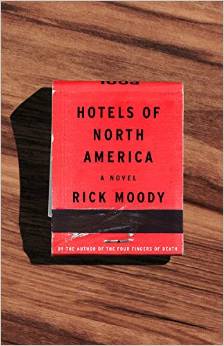
From the acclaimed Rick Moody, a darkly comic portrait of a man who comes to life in the most unexpected of ways: through his online reviews.
Reginald Edward Morse is one of the top reviewers on RateYourLodging.com, where his many reviews reveal more than just details of hotels around the globe—they tell his life story.
The puzzle of Reginald's life comes together through reviews that comment upon his motivational speaking career, the dissolution of his marriage, the separation from his beloved daughter, and his devotion to an amour known only as “K.” But when Reginald disappears, we are left with the fragments of a life—or at least the life he has carefully constructed—which writer Rick Moody must make sense of.
An inventive blurring of the lines between the real and the fabricated, Hotels of North America demonstrates Moody's mastery ability to push the bounds of the novel.
Literary
Garden State: A Novel (1992)

The first novel written by Rick Moody follows a group of friends in Haledon, New Jersey, through one spring in their rocky passage toward adulthood. They are out of school, trying to start a band, trying to find work — looking for something to do in the degraded terrain of their suburban hometown. Garden State captures the lyricism of stark lives in an intense and unforgettable story of friendship and betrayal.
The Ice Storm (1994)

The year is 1973. As a freak winter storm bears down on an exclusive, affluent suburb in Connecticut, cars skid out of control, men and women swap partners, and their children experiment with sex, drugs, and even suicide. Here two families, the Hoods and the Williamses, com face-to-face with the seething emotions behind the well-clipped lawns of their lives — in a novel widely hailed as a funny, acerbic, and moving hymn to a dazed and confused era of American life.
Ring of Brightest Angels Around Heaven: A Novella and Stories (1995)

From the concentric rings of strangers passing on a New York City street to the rings of madness in a vainglorious college student’s mind, Moody opens us up to a world of frustration, yearning, lies, and neglect whose frontline soldiers are the young.
Purple America (1997)

The story of Hex Radcliffe, a New York City publicist with a stutter, a drinking problem, and a terminally ill mother, who is summoned home to suburban Connecticut and finds himself confronting explosive circumstances and obstacles of comically epic proportions. As the novel unfolds in the course of a single weekend, Purple America lays bare the passions, delusions, and dreams of the American family.
Joyful Noise: The New Testament Revisited (1997)

Twenty-one American writers approach “The Greatest Story Ever Told” with a fresh eye toward its meaning for today. Seeking to reconcile their experiences growing up in the baby boom and Generation X years with their political beliefs and the fractious ethics of the late twentieth century, the writers represented in this collection have looked back to the source text of Christianity. Their essays, which offer interpretations of the New Testament that are eye-opening, passionate, and powerful, will be a source of reassurance and inspiration to anyone who has felt the need to approach spirituality in a personal or unorthodox way.
Demonology (2000)

Moody writes with equal force about the blithe energies of youth (“Boys”) and the rueful onset of middle age (“Hawaiian Night”), about midwestern optimists (“The Double Zero”) and West Coast strategists (“On the Carousel”), about visionary exhilaration (“Forecast from the Retail Desk”) and delusional catharsis (“Surplus Value Books: Catalog Number 13”).
The Black Veil: A Memoir with Digressions (2002)

In this searing, brilliantly acclaimed memoir, Rick Moody reveals how a decade of alcohol, drugs, and other indulgences led him not to the palace of wisdom but to a psychiatric hospital in one of New York’s less exalted boroughs. An inspired portrait of what it means to be young and confused, older and confused, guilty, lost, and finally healed.
The Diviners (2005)

During one month in the autumn of election year 2000, scores of movie-business strivers are focused on one goal: getting a piece of an elusive, but surely huge, television saga, the one that opens with Huns sweeping through Mongolia and closes with a Mormon diviner in the Las Vegas desert; the sure-to-please-everyone multigenerational TV miniseries about diviners, those miracle workers who bring water to perpetually thirsty (and hungry and love-starved) humankind. A cautionary tale about pointless ambition, and a richly detailed look at the interlocking worlds of money, politics, addiction, sex, work, and family in modern America.
Right Livelihoods: Three Novellas (2007)

At the center of “The Omega Force,” the first of three novellas, is a buffoonish former government official in rocky recovery. Dr. “Jamie” Van Deusen is determined to protect his habitat from “dark complected” foreign nationals. His patriotism and wild imagination are mainly fueled by a fall off the wagon. The collection’s second novella concerns a lonely young office manager at an insurance agency, where the office suggestion box is yielding unpleasant messages that escalate to a scary pitch. The book ends with a cataclysmic vision of New York City, after the leveling of 50 square blocks of Manhattan.
The Four Fingers of Death: A Novel (2010)

Excerpt: The Proper Exercise of Power
From the flaps:
“Montese Crandall is a downtrodden writer whose rare collection of baseball cards won’t sustain him, financially or emotionally, through the grave illness of his wife. Luckily, he swindles himself a job churning out a novelization of the 2025 remake of a 1963 horror classic, The Crawling Hand. Crandall tells therein of the United States, in a bid to regain global eminence, launching at last its doomed manned mission to the desolation of Mars. Three space pods with nine Americans on board travel three months, expecting to spend three years as the planet’s first colonists. When a secret mission to retrieve a flesh-eating bacterium for use in bio-warfare in uncovered, mayhem ensues.”
“Only a lonely human arm (missing its middle finger) returns to Earth, crash-landing in the vast Sonoran Desert of Arizona. The arm may hold the secret to reanimation or it may simply be an infectious killing machine. In the ensuing days, it crawls through the heartbroken wasteland of a civilization at its breaking point, economically and culturally — a dystopia of lowlife, emigration from America, and laughable lifestyle alternatives.”
“The Four Fingers of Death is a stunningly inventive, sometimes hilarious, monumental novel. It will delight admirers of comic masterpieces like Slaughterhouse-Five, The Crying of Lot 49, and Catch-22.”
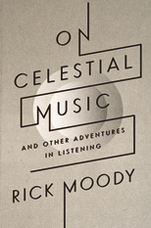
On Celestial Music— And Other Adventures in Listening (2012)

Rick Moody has been writing about music as long as he has been writing, and On Celestial Music provides an ample selection from that effort. His anatomy of the word “cool” reminds us that, in the postwar 40s, it was infused with the feeling of jazz music but is now merely a synonym for neat, “a grunt of assent.” On Celestial Music, which was included in Best American Essays, 2008, begins with a lament for the loss in current music of the vulnerability expressed by Otis Redding’s masterpiece, “Try a Little Tenderness;” moves on to Moody’s infatuation with the ecstatic music of the Velvet Underground; and ends with an appreciation of Arvo Part and Purcell, close as they are to nature, praise, “the music of the spheres.”
Modern groups covered include “Magnetic Fields” (their love songs), “Wilco”(the band’s and Jeff Tweedy’s evolution), “Danielson Famile” (an evangelical rock band), “The Pogues” (Shane McGowan’s problems with addiction), “The Lounge Lizards” (John Lurie’s brilliance), and Meredith Monk, who once recorded a song inspired by Rick Moody’s story “Boys.” Always both incisive and personable, these pieces give us the inspiration to dive as deeply into the music that enhances our lives as Moody has done—and introduces us to wonderful sounds we may not know.
Hotels of North America (2015)

From the acclaimed Rick Moody, a darkly comic portrait of a man who comes to life in the most unexpected of ways: through his online reviews.
Reginald Edward Morse is one of the top reviewers on RateYourLodging.com, where his many reviews reveal more than just details of hotels around the globe—they tell his life story.
The puzzle of Reginald's life comes together through reviews that comment upon his motivational speaking career, the dissolution of his marriage, the separation from his beloved daughter, and his devotion to an amour known only as “K.” But when Reginald disappears, we are left with the fragments of a life—or at least the life he has carefully constructed—which writer Rick Moody must make sense of.
An inventive blurring of the lines between the real and the fabricated, Hotels of North America demonstrates Moody's mastery ability to push the bounds of the novel.
The Long Accomplishment (2019)

Rick Moody, the award-winning author of The Ice Storm, shares the harrowing true story of the first year of his second marriage—an eventful month-by-month account—in The Long Accomplishment: A Memoir of Struggle and Hope in Matrimony
At this story’s start, Moody, a recovering alcoholic and sexual compulsive with a history of depression, is also the divorced father of a beloved little girl and a man in love; his answer to the question “Would you like to be in a committed relationship?” is, fully and for the first time in his life, “Yes.”
And so his second marriage begins as he emerges, humbly and with tender hopes, from the wreckage of his past, only to be battered by a stormy sea of external troubles—miscarriages, the deaths of friends, and robberies, just for starters. As Moody has put it, "this is a story in which a lot of bad luck is the daily fare of the protagonists, but in which they are also in love.” To Moody’s astonishment, matrimony turns out to be the site of strength in hard times, a vessel infinitely tougher and more durable than any boat these two participants would have traveled by alone. Love buoys the couple, lifting them above their hardships, and the reader is buoyed along with them.
Buy the Book:
Rick Moody, Life Coach
Writing constitutes an amazing way to spend your time, it is true, and why, you ask, would I have a dream of becoming a life coach, when I could just continue on in the present way, working on books? I have no response to this question other than the fact that my mother always suggested I should have something to fall back on. I always ignored this advice. However, especially in dark economic times, maybe it’s not such a bad idea. When I was young, I figured — if writing failed — I would be an arbitrageur, or a stockbroker of some kind, and then later, in college, I figured I would be a philosopher, or a psychoanalyst, perhaps a Jungian psychoanalyst. Then I thought maybe a librarian. But lately, I think that I would like to be a life coach.
I am not exactly sure what degree programs one needs to pursue in order to lay claim to the job description of life coach, but I bet the other Rick Moody (the basketball coach, usually associated with the University of Alabama women’s basketball program) has put in more of those classroom hours than I have. He, at least, can do the motivational speaking circuit based on his experiences on the court. My experiences have mainly been at the typewriter or word processor, a place where I am normally very alone. And yet I refuse to allow these things to stop me. Nor will I allow the grim facts of my own life — addiction, mental health problems, childhood in the suburbs — prevent me from realizing my dream. Those who can’t do, teach, it is said. Or else they can run for public office.
And so: while my website is not a site in which there are going to be many direct responses from me to direct queries lodged, there are spots here, and elsewhere online, where those with an urgent need may find someone who can find me, and if there are those of you out there who are in dire need, who require advice, I say bring it on. Bring on your problems. Bring on your lamentable instances of petty envy. Bring on your shoplifting addiction. Bring on your major depression. Bring on your head injury. Bring on your apraxia, or your Waldenstrom’s macroglobulinemia. Bring on your alchemical obsession. Bring on your hopes and fears and joys and frustrations. My idea of literature, as I have often said, is that it should save lives. My idea of literature is that it once did save lives, and was of consequence in that way. I believe it can do so again. With every book, to the best of my ability, I try to put this belief in action, even if, as in some of the recent books, the best way to save lives is to cause laughter. Bring on your problems, and I will listen, and bear witness, and when the occasion permits, I will respond, according to certain general rules, on this page, in this hope that here too words may be redemptive.
Dear Hesitant Before the Ambiguities NEW
Hello Life Coach,
I lost my mother Saturday, to liver failure. She had been in poor health for a long time and so her passing wasn’t a surprise, but of course it hurts. We lost my brother (her first-born) eight years ago and she never got over that, and I was grateful that her end was peaceful.
Anyway, it’s my father I’m worried about now, as his whole life has been built around caring for her the last several years, and now he’s alone (with his dog, who is unfortunately in advanced age). They were married fifty-two years. What do you think the lone surviving child should be doing for him (other than the obvious; I’m spending as much time with him as possible)?
Best,
Hesitant Before the Ambiguities
Dear Hesitant Before the Ambiguities,
Rarely has a writerly pseudonym been so evocative! And so rich! I’m trying to figure out on the basis of your note—short and filled with hardship—which ambiguities you are hesitating before. Let’s say, for a moment, that these ambiguities have to do with generational succession, and the way the illness and death of our parents confers ultimate adulthood on us. Whether we want it or not! Is the ambiguity to be found in the fact that you are fathering your father now? And thus, though you were only recently a son, now it seems like it might go the other way? That’s a rich ambiguity, to be sure.
The generational succession issue is also clouded, in your note, by the death of your brother. Having watched the death of a child (my sister) in my own family, having watched the effect of it on my parents, as you have done, I can only concur with the way it just devastates the order of succession. The parents are never supposed to watch a child die, and when they do, and must, the cost unparents them, very nearly, renders them again non-parents, but non-parents who have had a taste of the blessings of children, and now are robbed of these blessings. How do you come back from that ambiguity? That polyvalence of the word “parent.”
Or is there ambiguity, for you, in the simple act of survival when so many members of your family have not? That’s one that I have pondered myself. My mother lost every single member of her family by the time she was 38. Her mom, dad, and brother. And then she lost my sister, her daughter, twenty years after that. Her will to survive all this loss has always been astonishing to me. How to incorporate survival into self, without feeling somehow ashamed? Everything wants to live, of course, or most things want to live, but the human is the animal who has to live with grief, and nowhere for me is the drive to do other than survive, to court the opposite of survival, quite as powerful as when one is grieving. Only time helps here.
But you ask how to take care of your dad, in all this, and then you provide your own very appropriate answer: spend more time with him. So I imagine, Hesitant, that you are not only asking how to take care of your dad (for which you appear to have fine instincts), but also how to take care of yourself. In all of this grief, the easiest thing to do is to find a needy party and make like a machine of anticipation, which machine can find any problem that needs to be solved, vacuum! pick up prescription! write thank-you notes!, without ever slowing down long enough to ask: what is it that I need now, for myself, so that I too can go on and grow into the fullness of MY adulthood?
Is the hesitation of your pseudonym a recognition of the difficulty of this particular moment of self-care, a hesitation before the responsibilities thereof? Let me put it more plainly, Hesitant. Are you going to take care of yourself too? Is there someone who loves you to whom you can come home after the visits with your dad, into whose lap you can put your head and weep over all of this? At least as long as the weeping is still useful? Because maybe that is important under these circumstances. This Life Coach is too geographically distant come to your house, Hesitant, and provide his own lap, but this Life Coach hopes that these words might be like a literary fainting couch, where you could put down the immensity of your burdens, and allow the dermal layers of loss to shuffle themselves off in language.
Middle age, and one’s own death, these are the things that are bounded on the one end by the demise of one’s parents. Gazing at the dramatic extremities of this situation would cause anyone to be hesitant. But my argument is about not forgetting the great responsibility of middle age, taking care of ourselves! Recognizing when we have gone beyond what the body is able to accomplish. Or, put it this way, if we are to parent ourselves now the way our parents are perhaps no longer able to do, the thing we should remind ourselves of at the close of each day is this: “You have done enough today, and now you should rest. There will be plenty of time tomorrow to solve all of the world’s problems, and to make sure that all of your nearest and dearest can get through another day.”
All admiration for your selflessness in this sad time,
Rick Moody, Life Coach
Dear Ian Caton NEW
Dear Ian Caton,
You ask so many questions that your letter reads, in a way, like Whitman himself, and so I have taken the liberty of setting your letter as though it were a poem. It is herewith.
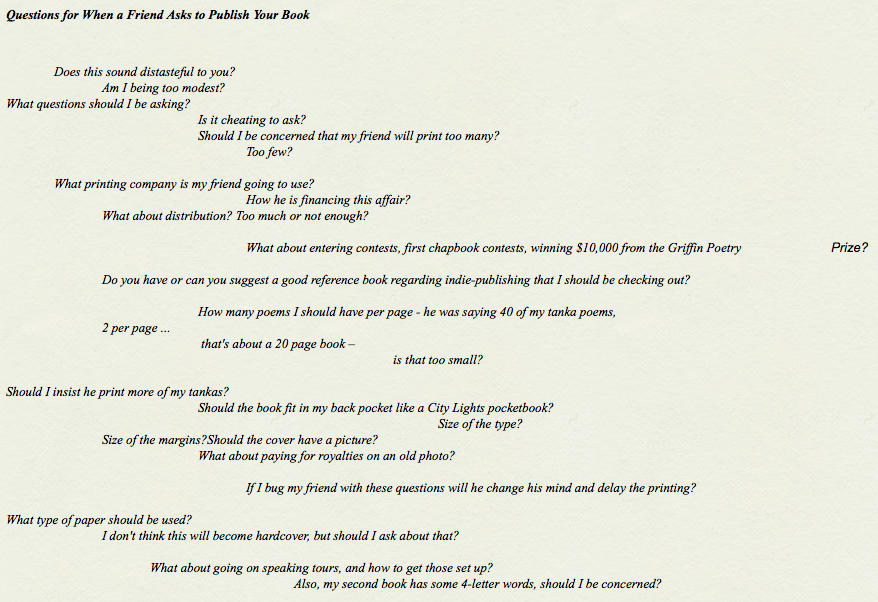
Ian Caton, these are all reasonable questions, really, and they are the perfectly reasonable questions of someone who is publishing his first book. Later on, when circumstances grind you to a pulp, you will ask fewer of these questions, because you will be more concerned with feeding your children, or surviving for another 24 hours. (This is not necessarily a good thing, but it is my experience.) Moreover, it will be abundantly clear (alas!) that some of these questions are beyond your control. My advice is to choose battles wisely in the publishing process, and to decide which issues are essential for your emotional well-being (font, let’s say, or front cover), and then allow for negotiations on everything else. As a general rule, unless you are Stephen King even a front cover is somewhat beyond your control, though you can influence this to some degree if you are graphically-minded and well informed about design.
Publishing a book is a collaborative enterprise, as such, you the author cannot have everything you want. So you should want fewer things, in order to achieve maximum satisfaction with the process. Interestingly, your insistence that your publisher is “your friend” strikes me as the biggest potential problem on the horizon with respect to your publication. Not the paper stock, nor the front cover image. I have found over the years that there is a natural tendency to become friendly with one’s editors and publishers, because you are working with them for a spell, sometimes for a long spell, and therefore you get to know one another, and it all seems quite friendly. But at the same time many of these editors and publishers work at the pleasure of their supervisors and they are meant to be making money for the corporation (this does not apply as rigidly with small presses, but neither are the small presses immune from the profit motive), and when there’s a hitch in capitalist part of the project your friendship is liable to feel secondary to business pressures. Your life coach has occasionally found this to be exquisitely painful, the friendship so quickly sacrificed for the sake of business. What a horrendous sentence is the sentence that goes: “Nothing personal! It’s just business!” One smiles through the grief.
The most important thing for a writer to do is work. What is unimportant are the facts of publication. Only marketing people should ultimately care about that stuff, and that’s their job, and it’s good that they do their jobs with such verve. But I advise finishing up manuscript number two, and then manuscript number three, Ian Caton, and let no man (and no front cover image) deflect you from that solemn task.
Best wishes,
Rick Moody, Life Coach
Dear Anonymous NEW
To Rick Moody Life Coach, From Anonymous,
I have an almost constantly racing mind—racing without any choice of subject at all. Often there is a rushing-in review of absolutely anything from the past, from any point in time, followed by an unrelated thought chain… It can be as mundane as a conversation with people in line at a bank, from twenty years ago! We discussed how to know who goes first at a stop sign when all arrive at once! And if it is at the 12 o'clock—where is 12 o'clock?????
I am ONLY 50, so I don't think this is an end-of-life kind of re-examining. I have indulged some selfish and decadent behaviors—and suspect that guilt makes my mind crowd out, rather than focus on, troubling episodes also… Another thing—I read books back-to-back(of course some of them have been, and will continue to be, your books) and can't NOT be reading a book, or I feel very lost…Possibly feeling like I've stopped learning…
Is it a mixture of these things? Are they related?
Thank you for your writer's wisdom,
Anonymous
Dear Anonymous,
I, Rick Moody, Life Coach, have a lot of identification with your note. With the symptoms you describe. While I am not a medical professional, I feel relatively certain that there are medical professionals who would pathologize your symptoms, based on your description, and give you something something speedy to alleviate your discomfort. But as we have all had enough of these sorts of solutions, I would like to explore other options here. First, I would like to explore the possibility that your need to be reading books back-to-back is not only non-pathological but wholly admirable, even slightly heroic. While I am loath to feel heroic myself, I often feel the same way about books. My wife would attest to the fact that I have feelings of nervous anxiety when I am out in the world without a book. In fact, if I am on the subway, or, worse, on a plane without a book, I am a very unhappy person. Sometime I will tell you the long story about how I was on my way home from Scotland, once, after an attempted terrorist bombing in the UK, and was told that books would not be allowed in my hand luggage. It was one of the most uncomfortable days of my life. My symptoms were close to withdrawal symptoms. I think, Anonymous, that your love of books makes you, in fact, better than most of your peers, and you should feel entitled to take some pride in this. Which is to say: the portion of your letter about books is a slightly heroic portion, for which, from this life coach, you will get only gratitude and admiration.
As regards the other symptoms—the swamp waters of the past, the racing mind—I see these as being, in part, the sign of the half-century mark. It is true, in terms of raw computing, that when you are in the middle of your life's journey, as I am too, more memory space seems to be given over to the past than to the present, and that the short-term events often fail to have pride of place in the cranial storage facility. Apparently, remembering conversations from middle school is far more important than, e.g., that student's name from my class last fall. It is upsetting to me regularly, this last-in-first-out storage protocol, but I also often find that if I slow down, court a bit of serenity, and avoid beating up on myself, all the cognition I need is there for me. At the same time, and I think almost any middle-aged person would submit, the cognitive valleys of this AARP time of life are matched by ever more wise and insightful human abilities. I know more about how humans feel now, and I care more about humans, than at any time in my life. The mildest poignancies around me, of a kind that I would scarcely have credited in my twenties, now seem almost operatic in their pathos. And I think this is a good thing. It means that I am attending to the present, even if I can't always remember the names and faces (I am so bad with faces!). You indicated this kind of wisdom, yourself, with your reflection about decadent behavior when younger. I feel your regret there, and that regret is the site where growth can take place.
The past is past. Look back, but don't gaze. And as for the present, and its hurly-burly of sensations, my advice is not to pathologize these feelings you are having, but rather accept them as the nature of circumstances. Be where you are! Because there are so few alternatives. You are not your younger self, but you are no less than your younger self.
And: I feel certain that when you and I meet, if we do, that we will have a lot to commiserate about.
Sincerely,
Rick Moody, Life Coach
Dear "Mom" NEW
Dear Rick Moody,
My daughter is a published writer (short story journals). She has an MFA from Cornell. She is 37. She teaches at a writers workshop for barely nothing. She also does tutoring. Three years ago she received an email from a well-respected agent saying he was interested in her work and could she send him her 50 pages? She has yet to do this she has 49 pages. We have had a series of unfortunate events happen in our lives. Her marriage ended violently soon after the birth of her only child, her husband went into a mental institution shortly before the breakup for five weeks - he was in the Navy, an EOD officer. The Navy had to step in and help her leave before he was released from the behavioral institution. She had a military protection order in place and they moved her to her childhood home. She then proceeded to get full custody of the child and a restraining order. He has only visited the child once, under my supervision. He has been separated from the Navy and has stopped paying child support. So we are on our own. She is hanging in there and is a terrific writer. She needs some sort of encouragement to continue on and I guess it is not enough coming from her mother. She grew up in a different world than this going to private school and horseback riding lessons. Any advice?
PS. She worked as a journalist for a magazine and interviewed many celebrities. She is extremely bright and a lovely person inside and out. She has lived in Rome and taught ESL there.
Dear "Mom," you didn't attach a name to your note, and thus, for today, and especially because of your maternal thoughtfulness, I'm calling you "Mom."
What you describe above, with your daughter, is a mountain of extremely good material, as far as I am concerned. Novels are made from adversity. Or, perhaps, human wisdom is made from adversity, and novels are made from human wisdom. The net effect is the same: lots of material. That said, there are the two kinds of writers in the world, those who produce the work and those who do not. The horrors of domestic turmoil have lain waste to many a writer, and there is no guarantee that one can manufacture in oneself the wherewithal to get clear enough of the turmoil to convert it into language. You, "Mom," cannot make her do it, nor can I make her do it. She has to want to do it.
I think for some writers there is no decision about this; the writing just happens. Turmoil is automatically converted to vowels and consonants. For myself, I find, as the poet Yeats said, I write to know what I think. I have no grasp on my own difficulties (they are legion) without finding a way to write about them. And thus whatever your daughter is going through she may feel now that it is too overwhelming, too time-consuming, to be written about now. But I say that writing about life is the only way to feel better about it! So why not?
Her credentials, as far as I can tell, are good, and she has the toughness to work hard at teaching, etc. Obviously, there is no guarantee that the agent will take her work if she writes the one additional page, but if she never writes the one page, she will never know. Finishing is part of being a writer, letting the work out into the sunshine of public opinion. Not easy, to be sure, but it beats the alternative. I urge her to do it, you are urging her to do it, and maybe there is real good that can be done by her converting all this hardship into literature. Maybe she can help other people. But she has to want it.
Writers can convert their luck at any time, if they really want to.
Best wishes,
Rick Moody, Life Coach
Dear Dinty NEW
Dear Mr. Moody,
Why do people, and by people I mean co-workers and students, erupt every once in a while with absolute crazy? How should I react?
Dinty
Dear Dinty,
I believe we are both laborers in the academic world of writing instruction. I will confine my experiences to this world, about which, like you, I do know a thing or two. This I say simply so that other readers of the Rick Moody, Life Coach, column can appreciate where you and I are coming from.
The semester is just over here in my neck of the woods. In fact, I write you just days after the end of the semester. And this semester definitely had its moments of the wobbly sanity. I could go on at some length, but I do not want the mentally ill or post-traumatic to feel unduly judged by me. I love all my students even when they are unsteady. I always feel their aches and pains.
Your questions are, 1) why? and 2) what to do about it?
The obvious answer to question #1, why why why?, is simply that a generous portion of writers suffer with symptoms of mental illness. I remember seeing a study when I was in writing school that argued that the profession with the highest portion of mental illness of all (and this may perhaps have included soldiering and lighthouse operation) was in fact the profession of “poet.” Somehow I felt slightly disappointed for being a prose writer, perhaps because I erroneously associated mental illness (I was 24 years old at the time) with heightened creativity. At any rate, it may be that the romance of writing (and its tendency toward madness), and the dark truths to be found there on occasion, attract some unstable personalities, encouraging them, in academic settings, to act poorly. And it may be that the academic life tends to be stressful and to drive people toward ends of the semesters in ways that are counterproductive to good mental hygiene. The workshop itself, moreover, is a highly stressful setting, in which supportive and helpful criticism is sometimes set aside and replaced with vituperations or highly competitive maneuvering between writers.
This would perhaps account for why the students are often crazy. But what about our colleagues? Why are they so capricious and enraged and bitter? This is a question I have asked of myself, over the years, many times. Why must academic politics, departmental politics, be so fractious and sociopathic? My working assumption has always been that the piece of pie is so small (one tiny endowed chair, one tenure track job), and the people competing for it are so ill-equipped to do anything else, that they imagine they have no recourse but to fight to the death. That would be a reasonable explanation of the phenomenon in part. Except for this: the bigger, better-funded departments, engineering or law, are just as riven with dispute. If you consider that academic life has its origins in monastic study, you would think we could all do better. The monks didn't need to hound one another to death. This secular monasticism, this monasticism with an excess of holier-than-thou should be so much better than it is, but maybe when you strip the God out of the guilds of study what you get is all the bad and none of the good. (Not that Christian education is much better! Maybe Christian education is more like secular education than ever before!) Perhaps I simply cannot answer this particular WHY, but I can, in my capacity as life coach, affirm your observations. Your observations are entirely accurate.
So, 2) what to do about it? I think you already know the answer here, Dinty, because I believe you have been at it even longer than I (and I am closing on my 25th year of teaching). The answer is to do as little as possible about the madness. This semester I had a bit of a stalking situation, a stalking-lite situation, which I had done nothing to encourage, but it embarrassed me to a great degree. I tried to do nothing for as long as possible, to stick to a bland and non-engaged kindness, such as I would offer any student, or anyone who expressed interest in my class. When this was no longer practicable, I did in fact solicit the department chair, to tell the student in question that I just wished to teach my class without incident and then to go home. Because that in fact is all I want to do. I love the actual subject matter of my classes—writing and literature—and I feel honored to teach anyone about them. Everything that is not about the dissemination of the actual material, between myself and student, is noise to me. I don't care about committees, I don't care about the institutions of higher learning, I don't care about my university, I don't care who's better or who's more attractive among the students, or anything else. At all. I care about the ideas, and the passing them on. So what I do, and I'm sure you do it, too, is tune out, or calve off, anything that is not the actual material of my class. I make myself as unavailable as possible for all the rest of it. In class, you get 100% of my attention, and out of class, you get as close to 0% of my attention as I can get while still maintaining control of my teaching project. This preserves the organism so that he can teach again another day, and also so that he may, on occasion, write.
Make sense?
Have a good summer vacation,
Rick Moody, Life Coach.
Dear Existential Dread
Dear Rick Moody, Life Coach,
I’m writing this letter because I feel very trapped. I’m writing this letter to you because you are the only person of my literary influences alive today. (The others who I would have considered writing this to, who I have written this letter to only in my head, would be Mike Gordon — more musical than literary — Sartre, Vonnegut, or David Foster Wallace. And, as I actually sit down to write this letter, I think to myself that you are probably the most level-headed out of the bunch so perhaps this is working out better than I expected.)
I’ve been told that I’m a good writer. People seem to like what I put out. I won a few poetry slams too. But I am never chomping at the bit to write for long periods of time. I chomp at the bit to come up with stories and I do that almost endlessly. I love creating the puzzle. I love making things work seamlessly. But then it comes to actually write the stories. When it comes down to it, I enjoy outlining the story and imagining the story more than I actually enjoy writing the story.
I was diagnosed with ADD when I was very young but I never realized the impact that it actually had on my life until recently when I made the decision that I was going to give writing a real shot.
I’m a graduating senior and I write this during my last winter break ever. I dedicated this winter break to pursuing writing at a more serious level than I had before. I found that I’m trying to balance on a double edged sword. If I take my medication, I can get work done but it lacks any real zest. I lose my creativity when I take my medication. Even when I take it, I can’t work for that long. If I don’t take my medication, I will be flooded by invention and creativity but there’s a catch: when the wind blows, I must find a new activity. I will actually get up and go do something else without having ever realized that I was doing something beforehand.
This does not fare well for writing stories. It worked when I wrote poetry because I could write it one line at a time but I’m bored with poetry. I much prefer reading and writing fiction.
I am told that I am a writer. I dearly wish I was but I don’t think I have the focus to do so. I feel very trapped. I have a drive to create stories and worlds but I have no drive to put those stories into writing. I don’t know what to do with myself. I feel as though I am becoming something, some person, and it defies my very efforts to shape it. I feel uncomfortable because I have every opportunity the world can offer and I feel that I am squandering my resources.
I think, and this is what makes me think that I am not a writer, that if I was a writer, I would want to write more. I’m not sure what direction to push my life towards. I’m at a crossroads but all the street signs are blank. I want to keep heading straight, on the road that includes writing, but the effort to keep my wheels straight makes me think that it's “not meant to be.”
Summed up, I suppose my issue is such: I thoroughly enjoy writing but I cannot commit myself to it as much as I try to do so, as much as I want to do so. I’m graduating in May as a Philosophy and Creative Writing double major without any real skills. I feel incredibly anxious that if I cannot be a writer, I don’t know what I can be. I have to like what I’m doing otherwise I’ll just be bored, frustrated, and resentful as I walk away. The only thing that really absorbs me is coming up with stories. Writing stories, past the outline, turns into a chore. All I want to do is put down what I’m working on and go to the next project.
Do you, in your new post as life coach, have any advice on what I should do?
Sincerely —
Existential Dread
Dear Existential Dread,
I’m writing this on the plane between Atlanta and Jackson, MS, not a place where I am all that often, nor a region where I feel terribly comfortable. But it’s what I have on my plate this week, and accordingly I have a fair amount of dread myself. So I should identify a little bit, and I do, at least with the part where you are wanting to write and having trouble finding the time and concentration in which to do it. Writing is always, these days, at this moment in history, in danger of being crowded out by seductions of the instantaneous. That, in far, is the great lie of digital culture, that things can always be more instantaneous. I was on a panel at South by Southwest recently, and I had to listen to a lot of this bunk about how the kids just want to be able to listen to the music now, and are not willing to tolerate having to wait, and don’t want to pay, because they think all the music is free, and that is the future. I just don’t believe this at all. I don’t believe the kids behave in a monolith, and I don’t believe that they are all against paying for things that they believe in, and I don’t believe they all believe that everything has to be instantaneous. I know in my own case, Existential Dread, that everything I have worked for and suffered for has been better than everything that I have got for free. Free is cheap, and cheap is usually the you-get-what-you-pay-for category.
But what happens if we want to make art but we just don’t feel like we have the constitution for making art? There are any number of questions I would ask in reply to this one, but perhaps the most important of these would be: what makes you think there is only the one way of making art? There are many ways to skin that cat, and some people manage to find ways to work within their limitations with great success. William S. Burroughs would be one example. Ginsberg had to assemble Naked Lunch for Burroughs because Burroughs just wasn’t up to coming up with a structure. Burroughs improvised the “routines” at the heart of the book, and then just dropped the leaves of paper in his apartment in the Interzone, and then it was left to Ginsberg to assemble a meaning of the whole. Of such things are careers made. A more recent example would be Mary Robison’s excellent novel Why Did I Ever, which takes the ADD life as a leaping off point for itself. The action, such as it is, and there isn’t much, is carved up into tiny bite-sized morsels, one-liners. Not much plot, not much character, occasional moments of drama, but more frequently just bits of comedy and weirdness. And totally great! Robison supplants the expectations of conventional fiction with these little filaments of language, and they are incredibly catching. You get taught how to read this book, as you go, and the edification goes down easily, with much delight.
One of the first things to do, perhaps, is to stop thinking of the symptoms of ADD as pathology, at least insofar as they apply to creative work. Your instrument is different from my instrument, but that’s all. (I have recently been reading Jonah Lehrer’s Imagine, and it has some interesting things to say about focus, about how people with focus are sometimes less creative and imaginative, because imagination, in part, depends on strange leaps and associations, associations that have little do with focus) So it’s not a pathology. In the end, it may be hard, because you have been taught for years that you should think differently from how you natively think. But maybe it’s possible to start thinking about this ADD business as an asset. That is exactly what I suggest you do.
Assuming following through on stories is a chore, how to make a story out of mere “outlines?” That part is easy, as far as I’m concerned. Try making a really big catalogue of outlines. What if you made a story that’s just called “Twenty-Five Outlines for Abandoned Stories?” A simple catalogue of all the stories you’ve never finished. Or what if you called it: “From the Library of Uncompleted Projects,” or what if you called it: “Need A Story? See Below,” and then people could write to you and request stories, and you would just give them one of the stories you have yet to finish? There are many ways to bend the structure of fiction, which is only linear and predictable now and then, so that it serves your particular way of being.
You have probably graduated now, or are about to graduate, because this has taken so long. And I apologize on that front. I have been teaching quite a bit lately. But I will say, now that you are a graduate, and likely a little anxious about what comes next, that all you have to do to be a writer is write, and if you really want to do it, you can do it. Just start where you are, and proceed along the journey in that direction.
Best wishes, Rick Moody, Life Coach
Dear Arthur
Dear Rick Moody, Life Coach,
First off — I’m stoked that you have this ‘life coach’ impulse. The idea that literature has a life-saving imperative is something I’ve always unquestionably believed from the moment I read Kerouac in my all-boys Catholic school and had my gourd rocked wholesale and it is downright invigorating to know that others share this faith.
The reason I am writing is because I am in dire need of a life coach — I have something resembling a set of half-baked questions which with due pluck I might be able to articulate, but more than anything what I'm missing is a soothing voice of wisdom whose counsel amounts to an understanding of what the meaningful things really are and how to fight for them.
I can ramble at length but in the interest of directness over too much ponderous word-wombatting some context might be helpful: I grew up in a small beach town in Queens once known for boozy Irish barfights, now increasingly under siege by Ray Ban clad Brooklyn hipsters with bad haircuts. My parents immigrated from Poland to bring me to streets of gold in America, only for my dad to find work paving the streets himself until he joined the electrical union and moved on to hanging temporary lights.
As mentioned, I went through twelve grades of Catholic schooling — wracking me with inexplicable guilt about all too many things and a strong affinity for Good Will Hunting hoodrat types. At some point in high school I found Kerouac and went from being a long time reader to a first time writer, waxing beatific with all the woeful teenage angst that is so glorious to lampoon but oh so profoundly important at the time. I found Brown through a track meet, and was sucked into the admissions spiel of a place where we could all be architects of our own educations. I originally had my eyes set on writing, without really understanding what it was, how to do it, or what learning to write at a place like Brown would look like. I floated through the humanities for the next four years, graduating with a degree in Africana — critical theory meets social philosophy, with a sprig of postcolonial race politics for flavor — ostensibly keen on understanding the shaping of worldviews as a net goal.
As it turns out, I graduated this past May dimmed from within on all too many degrees of academic sophistication, whatever embers of curiosity had me seeking an open education in the first place long since extinguished by the new SAT robot hustle. I went home and went back to work in the stained glass studio I grew up apprenticing in as a kid, until lo and behold I got a phonecall from a hedge fund in CT and am now forehead-to-desk deep in ‘work’ with a lease on a two bedroom in suburbia to boot.
In short, while I have a broad brush narrative of how I have gotten here and am by and large content with life as it is, I can’t help but hear the creaks of my bookshelves whimpering out that there’s something more to life that I might have dropped sight of along the way. At any given point in my soggy Marxist days in Providence I would have been on the other side of the Occupy fence, but out of a distaste for doing things for their moral veneer and the practical realities of a furloughed father and a vague sense that it’s better to be doing this vs. barbacking or barista’ing I find myself in the peculiar predicament of waking up a lap into a race I didn’t even know I was running.
I’ve read your Dear Anita and Dear Concerned Writer letters as well as your bit in the Atlantic which have been profoundly uplifting and directional, but my question/s are a little more spectral: What is it that drove you to writing? What are the experiences in life that have been most meaningful to you? How have you grappled with your sense of direction as your path meandered? What mentors, fictional or otherwise, have remained with you over time? Take these questions for what they are — vague attempts at articulating my sense of listlessness, feel free to answer whatever question it is I should be asking.
For what it’s worth, I apologize if this letter comes across as too literary — I have a horrible knack for putting on airs when writing about things that matter to me even to friends and family, meaning I’m self-concious about being self-concious and I wind up a postmodern turkey stuffed with confusion from the outside in. I’m not sure if you’re still teaching in the NY area or not, but if you have office hours or coffee time it would be totally boss if you had any time to chat as a mentor / life coach (if it cuts down on the need to reply).
Thanks, truly —
Arthur
Dear Arthur,
As I told others, recently, I have been a little out of touch with the Life Coach part of my life, partly because I was being a dad so much of the time, but I am back, at least for a little while. And I am moved by your letter, and by the decision to use “wombatting” as a word, and especially by using the double consonant in “wombatting,” which, back when I did a little editing, was considered “New Yorker house style,” c.f., “travelling.” I think the Chicago Manual might prefer a single t with “wombatting.” Let it be said: I liked the style of your letter, and I like the predicament: hedge fund guy with heart of gold. It’s not all that often I am called upon to give people advice on making too much money.
Here’s your relevant passage, as I understand it: “What is it that drove you to writing? What are the experiences in life that have been most meaningful to you? How have you grappled with your sense of direction as your path meandered? What mentors, fictional or otherwise, have remained with you over time?”
These are all big questions, Arthur. Part of what’s hovering underneath your uncertainty, in my view, is a particular legacy of your Catholic education: you want to be called to a profession. This is a way of thinking about vocation that is unique to people saddled with a Christian education, but that doesn’t mean that it’s so horrible. In fact, wanting profession to have romantic, ecstatic qualities is noble. Especially when, as you are, you are coming from a family when work was just work. You want to be called, and I admire it.
Maybe some socialist training at Brown helps with the idea of a “calling” as well. Because, after all, nothing is so Christian — in terms of its dogmatism, and its ideals, its valorization of the disenfranchised — as orthodox Marxism. I know it well. I was there when “politically correct,” as a locution, was born. We always used quotation marks when employing it in those days, but how quickly were the quotation marks removed.
In your wish to be called, you ask me, as I interpret it, if I was called to writing myself. And I suppose I would answer yes, if I could define the term my own way. For example, as to your first question — “What drove you to writing?” — I think I would have to say that I have no idea. I only know that I was driven. That is, some of the impulse was automatic. And a calling in this regard is that impulse that has no known causative agent (otherwise known as, in religious circles, God). I read a lot, and that was preliminary to writing, but in the end the writing happened because it happened, and assuredly not because anyone thought it was a wise vocational choice. Even I didn’t think so.
Your second question goes further afield: “What are the experiences in life that have been most meaningful to you?” I assume you are asking about this in order to try to assess whether I need meaningful literary experiences in order to want to write. But my list of meaningful experience is pretty far-ranging. My parents’ divorce was meaningful for me (in 1970), my learning to play soccer was meaningful for me, reading Moby Dick in high school, learning to play piano was meaningful, my bad LSD experience in 1978 was meaningful for me, my love for Elizabeth P. Breckinridge was meaningful for me, my first encounter with Samuel Beckett in 1979 was meaningful for me, first playing the electric guitar was meaningful for me, first hearing Music For Airports was meaningful, taking Semiotics 12 at Brown was meaningful to me, my sister’s death in 1995, my time in the psychiatric hospital in 1987, living in Hoboken in the mid-eighties, and so on. There have been many such things, not all of them about writing at all. Sometimes a great many different experiences can make of a person a writer, but mostly meaningful experiences just are, and should probably be treated as such.
Next, you ask about meandering: “How have you grappled with your sense of direction as your path meandered?” And the answer to this is easy. I love meandering! I will go wherever it goes! That is fine with me! I think it will all go somewhere interesting! So there is no grappling involved. Life is meandering. The idea that it has an orderly shape is an effect of the 19th century English novel. I think the aimlessness of life is very real, and part of the pulse of things as we experience them. “Digressions are the sunshine,” Sterne says, or something like that. So there’s no grappling here, only acceptance of the facts.
“What mentors, fictional or otherwise, have remained with you over time?” All of them, of course. I could do some kind of hierarchical ranking, but I don’t think that is in the spirit of your inquiry. Maybe the larger question here is: do I still feel that my mentors are relevant, and do I still feel that being teachable is relevant, and to this I can answer with a resounding affirmative. I have been thinking about the Buddhist concept of beginner’s mind, recently, trying to get myself back to the place in my own creative world where I don’t know everything, and I am willing to see things without the relentless armature of experience that I unfortunately bring to a lot of my work. With this in mind, there are mentors at hand, almost all the time, and being willing to accept them, being willing to accept what they offer, is part of growing and changing and adapting to what is creative about life. I am not perfect at it. But I try.
So, Arthur, you parents came here so that you could do better than they did, and you did, and you are, and you are making money, which is part of how people evaluate “doing better,” for good and for ill, and you had a fine enough education that you are now wondering if you might not do something else, something that calls to you. You think that maybe literature is calling to you. I can’t answer that part for you. And I can’t tell you how to weigh the burden that you must feel for having parents sacrifice for you in the particular way that they have. But I can say that there is no point in life, ever, where the route is foretold. There are always the accidents, the bomb bursts of the unexpected, the eruptions of history, the side journeys, and the dawning awareness that one might have done otherwise. If this isn’t the life you wanted, you can remake it at any time. And sometimes books are the thing that can best dramatize this road not taken. I know well how they can call.
Best wishes, Rick Moody, Life Coach
Dear Elizabeth
Dear Rick Moody, Life Coach,
I am not sure this is the email address to be sending an unabashed fan letter, but it is the only way I found to contact you on your website. I am writing you because I am a writer pretty much in total awe of you. I am also feeling lost with my own work, so sending this message to your Life Coach e-mail address is fitting, I guess.
Last year, I saw you read at George Mason with Jennifer Egan. I’m in the MFA program there. Your reading was excellent. I was a bit stunned in fact. We met for a second after the reading but I was feeling very shy that night. I even stupidly turned down dinner with my professor and Jennifer Egan.
Now I have just finished The Ice Storm — this morning, sitting up in bed. From page one I was obsessed by your structure — the tight two days unfolding the lives of the Hoods and the Williamses, the point of view shifts, all told by Paul. The Ice Storm is simply one of the most brilliant books I have ever read. Thank you for it.
I have also read interviews with you and articles and I know that for a long time you struggled with getting published. I’ve never been published, either, though not for lack of trying. I write fiction. I am working on a novel. I am struggling a lot with the structure — and because I am just sort of writing random scenes and notes and things about my characters, I can’t tell if I’m bullshitting. And thus my fear is that I am not a real writer, and certainly not a novelist. But then, maybe I am just in the beginning stages. And I guess, how will I ever know if I am a real writer? What’s a real writer? Does it mean being published? If I keep writing, I hope that makes me a writer. But does it?
Anyway, those are my Life Coach questions I guess. I want to thank you again for The Ice Storm. I have just ordered The Four Fingers of Death. I’m really looking forward to delving into all of your work, and trying to understand what makes you such an incredible writer.
Best, Elizabeth.
Dear Elizabeth,
The Rick Moody, Life Coach, franchise has been mothballed for a while, because I was trying to work on some other things, and teaching a lot, but suddenly there is a backlog of letters. I feel honor-bound to try to respond a little bit, lest you all feel that you are voices in the wilderness. And so here I am.
I am grateful for your kind remarks, which open your missive, but the substance of my reply will be paragraph four, i.e., your questions about the Years of Struggle, as I have often called them. The first important point is: there is no such thing as a real writer. What would the anatomical requirements be for a real writer? Is one a real writer only when has published for real. But of what would such publication consist? And if one had published for real, but then, e.g., fell silent, would one no longer be real writer? What if one only wrote letters, as Richardson is reputed to have done before he wrote Pamela. Would he not be a real writer, for having composed only his correspondence, before someone persuaded to try to make a novel out of the letters? And if he foreswore the novels (after three of them) and retreated to letters, would he no longer be a writer? Is a writer of unpublished writing not a writer? On what basis would real be relevant? Is real not merely a term bandied about by parents of young people when they are worried about the ability of these young writers to make a living? And if that’s the case, if it’s just a word for your parents, are you not duty bound to reject it? Why do we want to be real writers, anyway, when being an unreal writer might somehow be more heroic, and more kin with what it means to care about fiction as a form? In these times of alleged reality hunger, would it not be more noble, and more lofty, to be an unreal writer? It is, as the saying goes, a self-diagnosed illness, this thing of ours, and only you get to say when you are it. I would offer only one caveat, Eliz., and that is: writers are the ones who actually put words down on a page. If you are not writing anything down on a page, then it would be hard to lay claim to the term writer. The amount of writing is not germane. Nor is the instant value. Put some words down, think them over, and then make the self-diagnosis, if it applies.
As for novel writing: it’s just really very hard. There’s a reason why every other book, in my own case, is either stories or some other form. Because novel writing requires immense amounts of commitment. The more you commit, the better is the result. Think in terms of giving most of your writing time away for three years. That’s a reasonable presumption. At the end of three years, see what you have. And in the meantime, be extremely patient. The novel is the journey of a thousand miles that begins with a step. The first step has a lot of vertigo associated with it, but that’s okay. If you are patient and have courage, at the end of the long commitment that is novel writing, you will have something. And, at least from my point of view, anyone who writes a novel is the genuine thing, a writer of the unreal.
Best wishes, Rick Moody, Life Coach
Dear Residual Matter
Dear Rick Moody, Life Coach,
I’m not sure I know where to begin, let alone if I’ve ever begun or seen things beginning, and knowing where to begin always seems so displaced and incoherent anyway, like when I begin a conversation with someone and it all depends on that very moment from the get-go, whether or not she supports me in my research, he reproaches me for having asked for a recommendation, they reject me from whatever program or grant or conference.
So I’m sure I don’t know where to begin, but I’m asking you for advice because your writing always gets me, somehow similar to the way a friend gets me, or a lover gets me in bed, or even a bedfellow in the morning, when we wake up and joke about not knowing how we ended up next to each other in this particular situation, but I guess I’ve always thought of words as friends in most cases too, or at least, always as bedfellows, falling asleep with books most nights when I don’t have anything to worry me up until the crack of dawn.
More or less, I’m asking you where do I go from here. It’s a vague vernacular, how we ask for the going and never the coming, when the bottom line is contingency. But I’m in this sticky hole I’ve dug for an education, which has advanced me inasmuch as I can say I’m a comparativist and creative writer now, though most of my old professors would say, “Really?” and probably laugh after I’d left. The problem is I’ve more or less taken out a home mortgage to graduate with a BA, when in fact I live in a hole-in-the-wall apartment in Brooklyn with sky high rent. And I didn’t really want to live in this specific apartment, it’s just that the apartment I initially paid a broker’s fee for, well, the management company for that apartment screwed me over by not telling me I had bed bugs until three days before I had to vacate the premises of my old apartment in Crown Heights. So what do I do? I look at some twenty apartments in a day and pick the one that will let me move in the day before my roommates and I are evicted.
Anyway, I graduated, but in fact that’s not helped me become gainfully employed. Back on the student debt fund. And now I’m in an MA program, where I don’t feel comfortable with my knowledge of the idiom in which the professors speak, let alone with my attendance to social events and presenting myself, becoming a stereotype among competitive graduate students who aggressively attack each other’s egos while pissing in the bathroom, seeming to be a masterful candidate for a degree that also won’t help me do much of anything but teach foreign language classes in a language I still don’t fluently speak. I’ve always been a reader anyway, and a slow reader at that. The fact of the matter is that I’ve disappointed my advisor, I don’t have a third recommendation for my PhD. applications, and I’m thinking, well, maybe I should go to school for an MFA. But I doubt I have a third recommendation for those applications also.
Where do I go from here? It’s not like I’m totally alone in this boat either. My boyfriend’s sinking in debts, while he interns for a film distribution company. His parents, luckily, are paying back his student loans. Mine wouldn’t even if I fled to another country. And then there’s the matter of the dog, whose smile gets me in the sense of getting that immediately came to mind when I wrote that sentence three paragraphs back about your writing. I’ve been thinking about going to Hoboken but I hear the prices are just as high as in Brooklyn. I imagine this wasn’t the case when you wrote Garden State, lowest rent being somewhere around $800 to $1000 a month for a studio, though who knows?
My advisor is an especially critical thinker, whose criticism of my writing three weeks ago nearly devastated me to the point of concluding all my aspirations for becoming both a writer and a professor. My ex told me I’m just on the next level and I shouldn’t give up, but I don’t know if that’s the case, although I’m not sure there’s anything I can do as a back-up plan to teaching besides manual labor. Then there’s the other professor who said I reproached him, recriminalized him last year when I wrote him about my rejection from a department. But he’s not pleasant in any sense of the word: I’m sure he’s bound up in extremely sadistic ties to pedagogy. Yet, what he said still had me stuck in his office at a loss for words whose absence led to a tense feeling in my eyes and my own absence from his office. Tomorrow I have to present a talk at a conference, and my paper’s not even conclusive yet, though who can conclude when interpreting desire? Coextensive with this question, is what’s my desire in writing to you? What’s my demand?
Perhaps I wrote you in friendship, uncertain about whether I could even take part in a friendship with anyone whose writing I admire. After so much anxiety and worry over meeting my present advisor and speaking with her, I’m not sure I can admire my friends. I’ve started to return to what Jacques Derrida says about pity: how it’s the strongest drive in life with the exception of self-love. I imagine I’ve successfully failed at persuading you to let me learn from you, though I am a student at NYU. I’m on the internet thinking you’re teaching a class next semester there, maybe I can enroll in your course, if I could just find your e-mail. Then I find this place where I can ask for your advice as a life coach. I think twice about writing an e-mail just to inquire if I could at least audit your course, when I come to terms with the fact that I probably need a therapist of some sort but I’ve always been extremely resistant to therapists and psychoanalysts, I don’t trust their work, as much as I invest heavily in most of Freud’s writing as a critical thinker. Same goes for Lacan, if not more so in regard to his work. I’m still very much at odds with his law of the psychic life that every letter arrives at its design or destination. There’s a chance; there’s always a chance it won’t arrive, especially on time.
On that note, I think I should just send my e-mail and wait for your response. I see myself failing and falling, while there’s also the recent drinking problem I need to overcome. I broke my boyfriend’s guitar one night probably because we both had too much, and then I spent too much money on a ’68 semi-hollow Silvertone to compensate for my bad behavior, but I still feel like a real loser. To add to that, I still haven’t gone back to the dentist a second time to fix the front tooth I chipped while trying to keep a beer from overflowing this past summer. I have recurrent dreams about my teeth falling out now, though I never had them before I chipped this front tooth. It’s not so much unmanageable to have a tooth fixed or to stop drinking as it’s difficult to schedule my life in any ordinate way. Part of me wants to move far away, like to Antarctica — if only Werner Herzog hadn’t already romanticized doing that.
Looking forward to your response, Some Residual Matter to the Specter of Derrida.
Dear Residual Matter,
Part of what interests me in your note is the way in which you are repudiating both the origins of things—in paragraph one: “I’m not sure I know where to begin, let alone if I’ve ever begun or seen things beginning, and knowing where to begin always seems so displaced and incoherent anyway, like when I begin a conversation with someone and it all depends on that very moment from the get-go”—and likewise the idea of concluding—in graph six: “My advisor is an especially critical thinker, whose criticism of my writing three weeks ago nearly devastated me to the point of concluding all my aspirations …” Which would certainly seem to imply that you are a person much taken up with the middles, and this is supported as well by your use of the glorious word contingency, in graph three: “It’s a vague vernacular, how we ask for the going and never the coming, when the bottom line is contingency.”
Let me, in this regard, quote from Richard Rorty’s excellent book Contingency, Irony, and Solidarity that seems to have much to do with your situation, wherein he is describing the modern ironist: “(1) She has radical and continuing doubts about the final vocabulary she currently uses, because she has been impressed by other vocabularies, vocabularies taken as final by people or books she has encountered; (2) she realizes that argument phrased in her present vocabulary can neither underwrite nor dissolve these doubts; (3) insofar as she philosophizes about her situation, she does not think that her vocabulary is closer to reality than others, that it is in touch with a power not herself.” The feminine pronoun is in the original! Sounds like your letter a little, bit, huh?
Yes, there is relativism abroad in the land, and that is a good thing, and, yes, there is no location more likely to try to grind out of you all the relativism and all the irony than the modern academic department. Why it is that an endeavor that is largely based on the love of study, and text, and art, is so much given over to a kind of ritual child abuse that persists generation after generation, regardless of who is ambitious to work in the field and who is being spit out of it? I don’t know the answer. I only know that my own encounters with departmental politics in writing programs, etc., does not convince me that an MFA, as a degree program, will be substantially better than a PhD program.
Your predicament reminds me a little bit of a Chekhov story. Chekhov, in the reductive literary critical retrospect, is the author of the “slice of life” story structure, in which both beginnings and endings are missing. Why are they missing the beginnings and endings? Because “reality” happens in the middle, and is where things are less sentimental, less formulaic, less overdramatized. The middles are where things are more uncertain, more contingent, more human-scaled. And if there is a time of life that is most Chekhovian, most given to implication, and also to uncertainty about what comes next, it is youth.
Add to this, the sense that youth has these kinds of things as part of it—bedbugs, poverty, annoying academic advisors—the notion that America, post-great-recession, is a petri dish for desperation and uncertainty, and you wind up with the idea, Residual Matter, that you are probably right where you are most likely to be at the moment. In the years when no one knows what the fuck is going on. You have my complete sympathy. I lived through my twenties, but they were hard, and I suffered a fair amount.
That said, it is my passionately held belief, that no one who is drinking abusively has ever helped their circumstances dramatically by doing so. I can tell you, as this is a well-known feature of my own story, that I was not a good writer during my own period of problem drinking. So it is worth thinking about whether problem drinking, and the brownouts and blackouts, and the slaughtered guitars, and the suffering relationships that go with problem drinking are not adding to your burdens. There is plenty that can be done about problem drinking, as I’m sure you know.
Meanwhile, I know I’m slow here, as I took some time off from life coaching, but you’re welcome to sit in on my class, if you like. You have to talk though. No one is allowed to sit in without contributing.
Best wishes, Rick Moody, Life Coach
Dear Shit Gone South
Dear Rick Moody, Life Coach,
I just can’t seem to get my shit together since everything went south. What’s next?
Sincerely, Richard.
Dear Richard,
Before I get to answering specific questions such as yours, I want readers of this page to know that I recently composed not one but two short stories by gluing together answers to questions I solicited from friends. Advice stories! In that case, the respondent, the answerer, was an small-town advice columnist guy, who, in the course of responding actually went belly up. He deceased, that is, though this did not stop the flow of advice. At some point, these wholly fictional stories will turn up in a book, I suspect, a book possibly entitled Stories With Advice. I don’t want you (or any of the others who are reading this deep into the web site) to imagine that those stories, when they finally appear, are somehow influenced by this experience, the experience of Rick Moody, Life Coach. On the contrary, my regular life is always influenced by my fiction, not vice versa. My advice, here, in this specific locale, is shot through with my experience as a writer of fiction, and not much else. I am not really good at anything else, but the fiction writing. So my advice is confined thereto. It orbits around my experience as reader and writer.
That said, let me address your specific question. You are using fecal imagery to describe your life, Richard, and leaving the aside the issue that I too occasionally use fecal imagery to describe my own life, I wonder why this locution is so popular. What is it about “shit” that should be “together?” Why do we find this so compelling as a way of thinking about life? Why shouldn’t life, or our “shit,” be more apart, less coherent? I personally kind of like the unruly and predictable course of events when I am not controlling these events, and I find, in those moments, that the sense of not having to make orderly what is naturally disorderly is much more to my taste. So the first thing I would advise, if I were any good at advising, would be that you stop thinking of your life’s work as “shit,” and second that you stop attempting to assemble this “shit.” Which then brings me to everything “going south.” Again, I have used “going south” as a synonym for abject failure often in my own life, and I suppose that I have because I have mixed feelings about travelling into the often conservative regions of the Deep South. Would you still say your “shit” had “gone south” if you lived in New Zealand? Then you’d be talking about the South Island, which is actually a really beautiful place, and nothing like, let’s say, Tuscaloosa. I think we should try to recast the South in a way that is not so glum, as regards the colloquial usages thereof. If you purge the “shit,” the shit needing to be “together,” and the idea that “going South” is somehow to be avoided, then where are we with your question? Then you might be asking: Dear Rick Moody, Life Coach, life is unpredictable, what to do? To which I would answer: avoid prediction!
Best wishes, Rick Moody, Life Coach
Dear Dying Alone
Dear Rick Moody, Life Coach,
I have a gnawing suspicion that I will be dying alone. Perhaps it has something to do with the fact that everyone I know ends up leaving me. Perhaps it is because I live alone with seven cats. Perhaps I am helplessly neurotic. Perhaps it is because I live like a hermit and cry a lot. Nonetheless, this is my gnawing suspicion. What say ye, Rick Moody, Life Coach? Do you think I will be dying alone? Is this a question you can answer? Or have I mistaken you for psychic Sylvia Browne?
Sincerely, Possibly Dying Alone With Many Cats
Dear Possibly,
Who doesn’t die alone? Everyone dies alone. Death is nothing but one big glaring example of aloneness. Doesn’t matter if you are surrounded by a large family, or by a large supply of cats, you step over that threshold by yourself, and no one can do it for you. Not even Romeo and Juliet managed to figure out how to do that part together. Given that this is the case, why is dying in the company of others so absolutely essential? A good question to ask would be, statistically speaking, how many people actually get to avoid dying alone, if by not dying alone we mean in the company of someone who can hold their hand whispering, It’s okay to let go! Probably not as many as you would think, Possibly. Especially when you factor in the numbers of people who either die in their sleep or in assisted living institutions where they are not at all surrounded by loved ones, but by other elderly people of whom they know precious little. The whole fact of death, I will agree, is fearsome and hard to take. Entire religious traditions are built upon the anxiety with which we ponder that passage. But when you grapple with the idea that even your most social friends (I assume you have a few) are liable to die in circumstances not entirely different from yours (at least you have the cats), then what is it that is really bothering you? I suspect that the real question here is buried in the line: “Perhaps it is because I live like a hermit and cry a lot.” Why live like that? I ask. Because you do not seem as though you really want to live like a hermit, or that is my surmise, based upon the tone of the letter as a whole. And yet you have apparently elected to live that way. Was it Tillich who said: if you would be loved, make yourself loveable? I remember finding this passage really challenging as a teenager, because I believed, as a teenager would, that love should be unconditional, that that was the only pure love. I believed I should therefore be loved just as I was (as an arrogant, insolent, lazy, rebellious, unkempt, poorly groomed, garbage head of a teenager). However: there is no unconditional love in this world, just as there is no dying other than dying alone. And if there is no unconditional love, it follows that you might create conditions in which you, Possibly, were more loveable. In which you did not have to live like a hermit and cry. My idea of the brave journey of life, is this: that life is for being vulnerable and open. That does not mean open and vulnerable about attacking other people for their shortcomings and inadequacies; it means open and vulnerable to our own frailties and the frailties of others. Compassion follows upon this openness and, in my experience, friends and community flow in the direction of compassion. Community above and beyond cats flows in this direction, though I am in no way judging cats. Maybe you should try getting out of the house. And letting in the great unwashed out there.
And thanks for the excellent question!
Best wishes, Rick Moody, Life Coach.
Dear Angry Hegelian
Dear Rick Moody, Life Coach,
We are at the end of the World Cup and I have to be honest, I didn’t give a shit about it. I had to bite my tongue for a whole month, stay my hand every time I felt like writing a Facebook status update about how annoying everyone’s online cheering about the World Cup was. Even though the tournament will be over soon, my lack of caring about the World Cup has made me question my humanity. Am I human if I don’t give a shit about soccer players or national pride? Is there anything I can do to feel less alienated by such a stupid, long sporting event so I can prepare for the World Cup in 2014?
Sincerely, An Angry Hegelian
Dear Angry Hegelian,
I confess that the part of the letter that interests me most is your name. In what way exactly would I consider you a Hegelian? My understanding of the term, which mostly derives from too many hours laboring over Jacques Derrida in my youth, would suggest a dialectical view of history and philosophy. I am now going to go check online sources on the subject of Hegel and make sure my superficial understanding of the issues is accurate.
Okay, I am now feeling (having read up a bit) that it is not too rude and reductive to think that a Hegelian would have a “dialectical view of history and philosophy.” But why angry? And what does it mean to be angry and to have a dialectical view of history and philosophy? Does it mean that you are spurning the collapsed dialectics of later German philosophy — Nietzsche, e.g.? Does it mean that the international cultural politics being worked out in the soccer stadiums of the World Cup somehow force you into an unwanted dialectical view of history?
Of course, Angry Hegelian, you should like or dislike with complete commitment. You ought never feel remorseful about honest inclinations or disinclinations — life is too short. On the other hand, I have noticed that a certain political talk show host of the extremely right wing sort has recently made a point very similar to yours about the World Cup, and I’m wondering if, on that basis, you are feeling guilty, because your views are in accord with his? I, for one, would feel bad on that basis. Now, if we’re talking about nationalism, and about the kind of nationalism that seems to adhere to the World Cup (and to the Olympics), I couldn’t agree more with your note. Nationalism is a small-minded pursuit; it is, in fact, the refuge of scoundrels. Myself, I rooted for Ghana this time, because they were plucky, and because I wanted to see an African team dominate. (Alas not!) But I took no interest in the United States team, and this is true despite the fact (full disclosure) that I played soccer rather seriously in my youth (left wing, as it was called in those days).
The condition much to be avoided in this difficult and complex life is the condition of meta-worry. The worry about whether or not we ought to be worrying. That’s just autophagy. If you don’t want to watch the World Cup, don’t watch it, and let the fans go about their business happily. In the time that others are wasting in sports bars, you could, say, write a short story, or paint a canvas. Or you could just watch baseball.
Best wishes, Rick Moody, Life Coach.
Dear Lily B.
Dear Rick Moody, Life Coach,
I’m not certain a “life-coach” is the exact type of coach I’m searching for at the moment. I guess what I’m after is more of a “loss-coach”. Since you’ve written so often and so beautifully about loss over the years, would you be willing to switch hats for a moment from “life coach” to “loss-coach”?
Last year I lost someone very close to me. The cause was directly related to long-term addiction. Through grieving, I faced my own problems with addiction. It was with some difficulty and a whole lot of pain, I took steps and made some major life changes. There has been fallout — a great deal of fallout — from some of the decisions I made, resulting in more painful loss. Now endured without the benefit of any anesthesia.
I am fortunate enough to be able to work with a good therapist and have had amazing support from others in recovery. What’s been happening — and I don’t think this is uncommon — is that I’m getting my memories back, and some really awful stuff is coming to the surface. It’s sort of like the oil spill in the Gulf of Mexico: more and more black sludge keeps spilling out, more birds and fish keep dying, people try to help, but they ultimately end up recoiling when they see how bad and unpleasant things really are. And it stinks. I guess BP managed to put a cap on the valve this week. But the devastation is still out there. The loss is unfathomable. BP may say they are sorry, but they’ll never take full responsibility. It’s hard to imagine anything good will ever come out of it. I’m in a program where service and patience are emphasized. I’m fine with the service part — it helps; it feels good to work with others in the same boat. But I’m running out of patience. With most of the people I was once tethered to gone, there’s just not a lot keeping me here anymore.
This dark night of the soul has gone on a really long time. It’s like an Icelandic winter.
Kind regards,
Lily B.
Dear Lily B.,
I am honored that you’d send this note to me, when there are so many other people who are probably more qualified than I am. Before I say anything: I urge you to continue pursuing these issues on those other more professional fronts as well. Meanwhile, as probably many who would visit this web site already know, I had a great helping of problems in my twenties, and in the course of this bad patch I spent a little time in a very good private psychiatric facility in Hollis, Queens. Much of the useful information I have at hand (for nearly any situation) I learned there. Two things spring to mind from that time, with respect to the pain you describe: 1) proceed with every methodology available. Because you never know what’s going to work — so therapy, self-help, church, friends, square-dancing, whatever allows you some time and distance from grief and the obsession with it. It’s all worth trying. The other really good bit of advice from the psych ward is 2) don’t spend so much time alone. In the hospital we were never allowed to be alone — it was considered untherapeutic. You can’t learn anything alone in your room, if by learning we are meaning intuiting, intrapsychic feeling, and managing the kinds of normative behavior that enable one to be a happy and productive member of society. After a sequence of days in which I was kicked out of my room each morning, I found that I improved, and in the course of improving I decided that the one thing I really wanted, turns out, was to be a person among people, and not a terribly unique person, a regular guy.
It is true that the masses of men (the masses of humankind) are often broken, self-obsessed, hypocritical, and do not live up to whatever ideals they happen to be spouting in any particular period. These things are true and, in the idealistic view, they are lamentable. On the other hand, human civilization is finally all we have, and without it, we are back in the room alone, being untherapeutic. Freud speaks in, I think, Mourning and Melancholia, about the great truths that come from unhappy people, and the high costs that make these truths possible. Is it really worth it? I have often felt, in my middle age, that I would, in fact, rather be happy than right, at least if those are my only choices. Being right about the undependability of life, the hypocrisy of it, the difficulty of it, gets you little, except scorn, and loneliness. Being able to move past these things, forgiving the pitiable humans for being pitiable and human, gets you a great deal. Love, for one. For who would not rather be accepted than judged ill? Many things change in the cauldron of grief and loss, this is undeniable, and one must go through rapid convolutions and metamorphoses there. To me it sounds as though you are simply changing faster than you know how to manage. And perhaps friends and trusted confidantes are drifting off, because they are not up to the challenges that you exemplify right now. That’s fine, ultimately, even if it stings a little. I expect that new people, ones who are more amenable to the new shape of your life, will appear to take up the slack.
What would be a reason to stick around? Are you asking me? I suspect, Lily B., that in the recent past, perhaps with the family member you allude to, you have seen the costs of self-destruction played out among those left behind, and you yourself are giving eloquent voice to that legacy in your note. Ergo, any such sentence as “there’s just not a lot keeping me here anymore,” is, first of all, a tiny bit selfish, because it leaves out the collateral damage of doing otherwise to the near and dear, even those from whom you are temporarily estranged. But, more importantly, if you elect to recoil from life in the way some people do in your circumstances, there are many great things that you will miss: autumn in Northern New England, the Metropolitan Museum of Art, contemporary literature, any future tour by Leonard Cohen, really good chocolate, choral music, fresh maple syrup, pie, sunset over water, the Aurora Borealis, the growing-up of the children in your circle. Why not let these dazzle you while you await the strength to be able to deal with the rest of life, with the rest of the pitiable humans.
Best wishes, Rick Moody, Life Coach.
Dear Making Problems
Dear Rick Moody, Life Coach,
I have a longstanding issue with the idea that everything happens for a reason. It makes me particularly insane when people say it in what seems to be a sort of blithe way, and furthermore, that they know what the reason is. I’ve never been sure if it drives me crazy because I wholeheartedly disagree based on the (seeming/obvious) senselessness of some of the brutalities of life, or if I’m just envious that anyone seems certain of anything, or if there is some truth to it. There have been enough instances of events occurring in my life that I can find meaning in, that seem just to fall just outside the parameters of ‘random,’ for me to question whether I believe that at least some things happen for a reason, or whether I believe that things just happen and it’s up to us individually to find meaning in them, or not. (Is that clear, or only in my own head?)
I suppose I could have made this question simpler by just asking, Does everything happen for a reason, or not, and either way, how do we know?
Yours,
Making Problems Where There May Be None
Dear Making Problems,
I believe what you are asking about is the Parking Space God, existence or non-existence thereof. Many is the time, in my years of living in the alternate universe known as Self-Help, that I have heard someone boasting about having found a parking space right in front of the building (whatever building it is, the building in which they sought aid and counsel), in the course of which this someone then leaped to believe that their appearance on the premises was ordained by God, ordained precisely by a Parking Space God, who not only has time to pull the strings in many other areas, many more important areas, but who apparently has in past, present, and future, entire divisions of minions given over to making sure that the Elect have proper spaces in which to allow their dented jalopies to cool.
In fact, if I’m being completely honest (and what sort of Life Coach should be anything but), I went through a period of this myself, in the first couple of years after I got out of the psychiatric hospital and began to right the craft of my life somewhat, in which I was myself a believer in the Parking Space God. Yes, it was true, things were going a lot better, and I was not getting into the same kinds of trouble I had in the past. Yes, it was true, whereas people had on occasion steered around me before, now they seemed to enjoy my company, at least on occasion. Yes, it was true, in general that there seemed to be a good orderly direction to the way things were going, and, most of the time, if I needed parking space, or the equivalent (by which I mean the trivial needs of life), a parking space appeared. Things seemed pretty good.
Until my sister died.
I expect that this is the kind of calamity you are alluding to above. It is true that some others of my acquaintance have been through worse things. But for me, this was plenty bad enough, and it was a lot worse, a lot harder, on others I care about, on my sister’s children, for example, who were in the front row for this hardship. They had to grow up with the scars, with the hardship. And while, in a certain way of thinking about theology, it might be that god (I’m deliberately lower-casing here) pre-formatted creation with such horrors already written in, especially if you read C. S. Lewis’s not entirely helpful The Problem of Pain, it’s more likely, as my cousin said at my sister’s memorial service: God does not cause these things to happen, God allows these things to happen. I think my cousin was trying to describe his own grief about my sister’s death, and trying to help the rest of us. It didn’t help me then, and in the fifteen years later, I have only begun to scratch the surface of this sentence. I now find it interesting, if not comforting entirely.
It would seem, therefore, that the Parking Space God does not control random, unforeseeable deaths, and the trauma associated with them. Or, if those things do happen for a reason, the reason that they happen is hard to fathom, and unimaginable for those of us who live here on earth. Therefore: either one had better imagine a much more cogent theology (which would certainly be my choice) than the one indicated by the adherents of the Parking Space God, or one had better conclude that there are no reasons at all, there are only our daily rounds, and the mix of good and bad contained there. I have no problem with atheists and agnostics believing that all is happenstance and human will is the only agency, or with concluding on the basis of this or that example of genocide that there can be no theology of a workable sort at all. I just wish they would not get up in my face. The same can be said of the adherents of the religion of the Parking Space God. They are just as intolerant of those who disagree.
I suspect, as in so many other areas of life, that there must be a middle way. I suspect that the middle way, and its middle roads, is the place to dwell. And I bet you have found this as well, or else you might not have posed the question in the first place. Rest serenely in this intelligence of yours, Making Problems, you are onto something.
Best wishes, Rick Moody, Life Coach.
Dear Size Four
Dear Rick Moody, Life Coach,
I met someone just about a year ago. We dated for three awesome months and then he moved to Mexico City for a job. We tried to keep the relationship going, but six months later I broke up with him because we didn’t really seem to have much to say to each other anymore and I wasn’t clear on when he was returning. Guess what? Two weeks after we broke up he started dating a younger American chick who also has the exact same high profile academic background as he does, also living in Mexico City, also likes bad music like Jason Mraz and show tunes. He then announced that he is moving back to Philly in August, one year after he left—and I think she is moving back to the States also. I still think about him every day. I think about the other chick every day too. It’s awful. I’ve never regretted breaking up with someone. I fear I will regret this for the rest of my life, and yet I also don’t think we are “meant to be” in the sense that he doesn’t like Woody Allen films nor is he very culturally literate (he is an economist). I also fear telling him how I feel and him saying that he got over me when I dumped him (something he has hinted at in email). What do I do, aside for pay $150/session in therapy?
Sincerely,
At Least My Lost Appetite Means I’m A Size 4
Dear Size Four,
Any letter that contains the words “I fear I will regret this for the rest of my life” is a melancholy letter. Maybe it’s because I have used these words before myself, and I know that it is not easy to type them out. Maybe it’s because anyone who uses the words “I fear I will regret this for the rest of my life” engages in an uncommon amount of reflection, because, I believe, most of our colleagues in the journey of life never regret much, or, if they do, they avoid admitting it. Politically and professionally, copping to regret is the sign of weakness, and as goes our so-called leadership, so go the better part of our peers. Therefore: admitting to regret is one of the bravest things a person can do these days. It’s especially radical in this psychic landscape of would-be invulnerability. It’s not weak, in fact, it’s surpassingly strong. Therefore, let me say, I too have regrets. Lots of them. Sometimes I am kept awake by regrets.
However, what is it that you think you regret here? I think the regret in this letter hinges on the use of the words “meant to be,” and on whether “meant to be,” even if not exactly the case with this economist fellow, is somehow language that one should entertain, at all, or aspire to, in the area of relationships. “Meant to be,” along with that other usage that sounds even more monotheistic to me, “the one,” as in “maybe he’s the one,” is, I think, extremely unhelpful language. “Meant to be” lists in the direction of magical thinking. The implication of “meant to be” is that there is an order to how relationships go in our lives, and this order is toward one slab of monogamous relationship which will render all others irrelevant. Now, I am not at all against a personal life that prizes intimacy and the practice of greater and more rewarding evocations of the intimate; nor do I think monogamy is problematic for the great majority of persons, who tend to operate like swans, and that’s fine, swans are pretty, if ornery. And yet I have a problem with the idea that simply because you spend your life on a partner this partner is somehow “meant to be” or is somehow “the one.” In fact, according to my view, “love” is almost exclusively a verb. Love is a way that you act upon a person, not a resting state. “In love,” a particularly effervescent bromide among the usages of love, is sort of ridiculous, the way I see it. I do not tend to think of “in love” as referring to much. Whereas “love,” the verb, is so rich. “I loved her. I love him.” These are beautiful sentences. When you say that you love someone, regardless of who they are or how they are, then you bring yourself into some kind of equalizing relationship with him/her, by wishing for their good, for their flourishing, without requiring a response. Then you are saying something rich. Paul Tillich, I think, refers to this, in a theological context, as “loving action.” When we are in a relationship with the divine, according to Tillich, we are experiencing “loving action,” wherein the two things, “love” and “action,” are somehow identical, wherein both lover and loved are changed, made better, by the process, by the drama.
According to “loving action,” it seems to me, you, Size Four, could love anyone at all. All you have to do is get busy with the project. You could love, as Stephen Stills memorably suggested, the one you’re with. This sort of approach (this loving with or without consideration of the “worthiness” of the object) would obviate the “meant to be” considerations that, despite your wishes, are lurking around generally in the deep space of your letter. In fact, I think “meant to be,” the concept, is a relic of a time when the morals of the state were arrayed against the absolute liberty of love. “Meant to be” implies that you are unlikely taking some time considering from among a pool of reasonably appropriate targets, each as good as another. “Meant to be” implies that you will never tire of your lover, hate everything about him, and find it all grinding and difficult. But love, in the day in and day out of the world in which we live, is always contingent, is always provisional, is always here today, and gone tomorrow, though you may renew it, actively, feel it in its (to use a Colbert-style coinage) verbiness, at any time that you wish to renew it. With the aforementioned loving action. You can love someone else tomorrow, some reasonable party, and you can work on it, just as you worked on this relationship with the economist. Or not. You can do exactly as you wish here, and you can, and ought, do so with a feeling of empowerment, as long as you know that love is good and that you are made better by doing it, by manifesting the verb, actively, instead of casting about for that passive arrangement—“in love.”
If this is all true, if love is active and mutable and if it changes you, constantly, and if you are made different, no matter the target or the object of your affections, doesn’t it follow that you should have no regrets at all? I honestly believe that you should have no regrets at all. And I am talking to myself here, as I say, as much as I am to you. My regrets all have to do with feelings of social failure, as though despite my ambitions for love and work I have failed to meet the minimum of social obligations I am honor bound to observe. But, if I am free to love and work absolutely, are not the “failures” just manifestations of growth and improvement along the path of enlightenment, and doesn’t it therefore follow that I should regret nothing at all?
On the other hand, there is Jason Mraz. I confess that I agree with you about Jason Mraz. Jazon Mraz could be a dealbreaker. Likewise, John Mayer and Jack Johnson. And while I know a Life Coach should refrain from hating on popular musicians in his published column, in this instance I can’t help myself. Maybe you are better off without him.
Best wishes, Rick Moody, Life Coach.
Dear Ex Libris
Dear Rick Moody, Life Coach,
I am writing for advice regarding an aspect of my life that approaches obsession. I am obsessed—not with smoking or porn or drugs or any of the other more vicious vices—but with reading.
This doesn’t sound like much of a problem. But it sometimes feels like a problem. I worry, at times, that my desire to read means missing out. On life. I have children. I have two dogs and a cat and a spouse I really love. Despite my devotion to them and to various friends, I often find myself wishing that I were—instead of playing ping-pong with my 12 year old or enjoying a meal out or walking my two fine dogs—that I were reading. During a nice bike ride around the neighborhood with my family, I wish I were reading. We settle in to watch the occasional excellent episode of Friday Night Lights, and I wish I were reading. I go to bed ridiculously early so I can wake up equally early so I can read for hours before having to deal with “real” life. (We are, in fact, at the beach this week and though I have gamely collected shells and played hearts and watched various DVDs at night, all I want to do is read).
Now, this is no big crisis. My quality of life isn’t adversely affected in any significant way, I don’t think. Nor is the quality of life of my friends or family (for the most part). It’s more that I want a different way to think about my obsession. A healthier, more comfortable way to think about the fact that I really pretty much just want to read all the time. If that makes sense.
With thanks, in advance, for your thoughts,
Ex Libris
Dear Ex Libris,
As far as I’m concerned, you don’t have a problem. Since I know a little bit about addiction—more than I wish I knew—I know and take it as an article of faith that one can be addicted to anything. It is true in my own life. Where the really bad stuff went in my life, back when, there is now a sequence of really annoying minor addictions that almost no one would consider bad (coffee, chocolate chip cookies, Diet Coke), but which manage to be irritants for me. I give up one thing, and another compulsion surges forward to take its place. The addictive fetish item, whether it’s heroin, spirits, prostitutes, gambling, or Diet Coke, can vary in its distinctiveness, and its bad reputation. What matters most is the relationship we have with the item. And that’s how you assess whether you are in the clutches of addiction, according to how you feel.
Chief among the signs of genuine addictive behavior is that the behavior affects family life and/or professional life. These are easy things to identify. If you are actually going on the bike ride with your kids, or you are actually watching Friday Night Lights with your husband, despite your desire to read, and if you are then reading when you can, and if your family knows of and esteems your reading, is not terribly much bothered by it, then your reading is not, in fact, an addictive problem. Let’s say you were addicted to exercise, which is a common compulsion among newly recovering addicts of various stripes: then you would be skipping dinner with the kids, because you had to get in your 12 or 14 miles of running that afternoon, and you would be scheduling your sixth marathon of the year, even though you just had a knee injury last year, or even though your kid is performing in the school play on Sunday. And so on. I think you know all the signs. I think you are sensitive enough to know the signs, or else you would not be writing this letter in the first place.
Reading as an addiction (and it’s distinct in this case from book collecting, which truly is a gentle madness, as others have noted), even if it were your difficulty, has a real upside: it almost always improves you, it takes you somewhere exciting, it renews language in your life, and it often sews a most distinctive happiness wherever it takes up residence. If you got so badly addicted that you had to go read all of Samuel Johnson’s dictionary, or all of The Man Without Qualities or A Dance to the Music of Time, I would say you were a lucky addict. I would envy your addiction. But this is not your situation, not as I understand it.
What I really think you are saying, Ex Libris, is that sometimes family life is boring. What I imagine you are saying is that sometimes ping pong with your 12 year old is not what you have in mind, and that maybe, just maybe, Friday Night Lights is not as good as Vanity Fair or Gravity’s Rainbow. I suspect you are going to argue with my theory here, because no one, least not a parent in a reasonably happy family, is going to come right out and say it—domestic life, while incredibly rewarding in the long run, is, on occasion, boring. This is not necessarily a bad thing. When you commit to your family despite the fact that family life is sometimes boring, you are being both selfless and generous, and the sign of this generosity is that your kids grow up grateful for all you have given them. And you have given a lot. You have given up The Compleat Angler and Invitation to a Beheading and The Monk (I’m trying to include relatively minor works here that I haven’t gotten to yet), and all of the lesser works of Fielding, and the like. I know this is hard. But I also know that you are doing a great job as a parent by compromising here. And when you admit to yourself that you make this choice despite the fact that family life is sometimes boring, you are leading the examined life in a way that is a credit to you.
You are no addict, then, not in my view. You are a supple thinker twice over, a sensitive, because you are a reader, and all readers are supple thinkers, and, moreover, you are wise enough to know that there are times when you have to choose to be otherwise than a reader, for the betterment of those who need you now and again. I think this admirable indeed. Yes, Ex Libris, I admire you. And your letter.
Best wishes, Rick Moody, Life Coach.
Dear Maybe Baby
Dear Rick Moody, Life Coach,
After 20-odd years of relationships long and short, blind dates, crushes, stretches of celibacy and the occasional one-night stand, I now find myself on the cusp of 40 and single. And I think I want to have a child. I have a sperm donor—a wonderful old friend—picked out, and I just got tested for all the genetic diseases that commonly afflict people of my ethnic background.
But I’m having a very hard time making a final decision about whether to proceed. When one is in a marriage or long-term relationship, I think the decision to have children is often semi-automatic. It’s what couples do. They procreate, maybe because they want to commemorate their love in the form of another human being, maybe because they figure it’s the next step on the ladder of adulthood, maybe because they’re disillusioned and want something they can love unconditionally. But when you’re single, it becomes a very, very deliberate decision. You can’t just be ambivalent and figure, “What the hell, let’s skip the diaphragm this time and see what happens.”
So I’m struggling with this decision. I keep thinking that having a child is a selfish act. Selfish because the world doesn’t need another person, and I would be doing this because it’s something I want to do. My imaginary baby doesn’t need or want to be born at this point. I know that once the kid arrives (if the little squirt does arrive), the selfishness of the urge will be converted into the selflessness of the act of parenting. But yet, I’m a little hung up on the selfishness. If I so want to devote my energies to someone besides myself, why don’t I get a dog or join the Peace Corps?
And then, there are all the other things causing me pause—the regret over not doing this the old-fashioned way, the feeling of loneliness at not having another adult to share my life and the experience of parenthood with, the sadness that no one will love that kid as much as I will, the fears that something bad may happen to me or my child and one of us may be left without the other.
If you can address just one of these—maybe the selfishness issue—I’d be grateful.
Sincerely,
Maybe Baby
Dear Maybe Baby,
This is a really beautiful and sensitively composed letter. I admire the spirit in which it is written, and I admire you for writing it. Just the fact that you would be as open to the complexities of parenting as you are means, to me, that you would likely make a remarkable parent, a remarkable mother, one whom this baby would be lucky to have.
I should say that as a relatively new parent myself I have many, many opinions about parenting, and in some cases my point of view is now diametrically opposed to the way I felt when younger. For example, when I was younger, because of the difficult circumstances in which I was raised (in a broken home), I often argued that single parenthood should be a last resort. I felt keenly, that is, the absence of my father from my life, and the divorce of my parents weighed heavily on me. This despite the fact that my own siblings reported no such lingering wound. They had their problems growing up, my siblings, but revisiting my parents’ marriage and the circumstances of our childhood were not among them.
For many years, especially in my early thirties, I also often made the “selfishness” argument about parenting. In just the way you are making it. And it’s true, now, that I feel that genetic reproduction has a whiff of the narcissistic about it, and given that this is the case, I do feel that we should not ever feel that genetic reproduction is our only parenting option. There are, after all, a lot of babies, a lot of children, out there, who need love. But let’s be serious: there is nothing quite so selfish as refusing to be a parent. Since nothing on earth, nothing that I have experienced at all, is as selfless as raising an infant.
Want a lesson putting aside short-term gratification for years? Have a baby.
With all of these things in mind, however, let me say that while I think the decision to become a parent is best made in a methodical way with plenty of forethought, we don’t always have this option. Sometimes we have deadlines. Sometimes we have unplanned pregnancies, and so on. It’s foolish to believe that we would hold the way a decision is made against the result. That is, many an adopted person of my acquaintance (and I know many) is of a sterling cast, and in all these cases, the child was born initially to parents unable to care for it. Any child at all, in fact, is a blessing, especially to a woman your age (I believe I am just being statistical when I say so, and do not mean that I think a woman in her late thirties is somehow older), and a blessing is a blessing, and we would be wise to find the good in it, whenever we are able. Ingratitude is really the worst failure in the portfolio of human behavior.
Make no mistake. Parenting is hard. I for one am not always capable of doing it without mixed emotions, and I look on the hard work that my wife does, that most women do when they are mothers, with awe and humility. (And I am not saying this as a father who cedes most of the work to the child’s mother. I am fully involved.) You already know this. It’s in your letter. And you already know that it’s harder for single mothers. I have known many, and they have had their hands full. But that doesn’t mean that what you propose is not going to be amazingly rewarding. I have never had such rewards in my life as those that have accrued to me because of my daughter, Hazel. I could go on and on and on here, but I will instead try to say it plainly. For the longest time, I believed that my contribution to the world, for good or ill, was my writing. But, as I have often said, when my sister died, and I became close to her children, those she left behind, I put aside the selfishness of the literature-above-all point of view, and it was in that period of great and sudden change that I came to see that I could eventually parent. While I will never be a person who thinks that family is the whole of life, I love my child without any reservation, and in a condition of great vulnerability. She makes me a much better person.
You ask if anyone will love your baby, and you feel regret about not having her or him in a more conventional way, in the dyad of long-term monogamy. I know I can’t talk you out of these feelings, and I would feel the same way if I were you, whether rightly or wrongly. But I can say, and I don’t mean this to sound trivial or sentimental at all, that I would love your child, and I am willing to bet that all your friends who are also parents would love your child, and I bet there are men out there, men of character, as well as women of character, who can love you and your child. The world is not devoid of the big-hearted, of those who rise to the occasion and feel better about things when they involve sacrifice and hard work. In fact, though these persons are often less glamorous, there are lots of them around. Your child may need to be raised in a community of this sort, people who are willing to help, and who care, but he or she could do a lot worse! In fact, the Clintonian village that will help raise up your bundle of joy may make her that much stronger and more accomplished. So: I don’t want to be flip when I say what I am going to say, because I understand what a big deal it is. Few, right now, can understand it more than I, because I have been up nights, on and off for eighteen months, and I have let opportunities go by that I used to jump at, and I am not breast-feeding or performing the other ministrations that more often seem to fall to mothers. But what I want to say is: feel supported in this. If support is what you need, then know that that support is there. The love you give will be given back to you in multiples. It really will.
Sincerely, Rick Moody, Life Coach.
Dear World’s Greatest Dad
Dear Rick Moody, Life Coach,
My wife and I recently did our patriotic duty and created a baby. He is delightful! But we’re finding that he is very expensive. We have tried to mitigate those expenses by choosing to breastfeed, hold off on daycare, and deny him the more colorful and musical of baby toys (which he will likely lose interest in long before they are due to be retired, if one considers that a fifty-dollar musical toy that lights up when smacked with a baby palm should entertain for at least six months).
During one of our sleepy discussions, the only discussion we have these days it seems, my wife and I considered using our baby’s unrivaled cuteness and good temperament for financial gain. Ad companies love babies and puppies and while our dog is far too old to sell things like floor wax or beer, our baby is cute enough to sell things like tires and soft towels.
Yet, my wife and I disagree on a key point. I want to use the money he earns to pay for bills and daycare whereas she believes the money he will potentially earn doesn’t actually belong to us. She wants to put it in a savings account so that he might spend it on college or a vehicle. She seems to have forgotten the fact that we do not want him to go to college but would prefer he attend a reputable trade school to become a plumber or electrician (i.e., someone useful).
I guess my question is, do you think getting my baby into commercials is worth it? Financially and, you know, ethically and stuff? I hope you can help us resolve this issue. And quickly, as he grows more and more each day, which limits the potential commercials he can audition for.
Sincerely,
World's Greatest Dad, New Jersey
Dear World’s Greatest Dad,
I think the correct advice with respect to this letter is Hammurabi-esque, which means that it involves compromise. You and your wife are both right, to some degree, on the issue of your child’s wages. And the only problem is that you are each dug in and unwilling to meet in the middle somewhere. If, in fact, what you might do, in order to keep the peace on this matter of your son’s career, is simply put away exactly 50% of his earnings for college while using exactly 50% of the cash for day-to-day baby care issues. That would solve that. In a good compromise everyone gets a little and gives a little.
It goes without saying that none of the money is for you, though. It’s all for him. Unless you want to go live in the hell that is inhabited by Britney’s dad. Or Lindsay Lohan’s mom. Or Andre Agassi’s dad.
There is a larger question, though, and the larger question is: what does it mean to sell out these days? When I was a youngster, in the days when the phrase politically correct, for example, was just becoming a phrase that people uttered without irony, this was a putdown that we often used. He or she was a sellout, or was selling out, or had sold out. Such and such a punk band had sold out. Such and such a video artist was now selling out and trafficking with the Hollywood jackals. In the old days, one took a rather hard line on these sorts of things. One avoided overtly commercial or pro-corporate behavior. One was, above all, suspicious of large corporations. (I still am.) Remember when Neil Young sang that song “This Note’s For You,” burlesquing all those other rock and roll types who had licensed their songs for commercials? That was good. That was a good moment. Did you happen, on the other hand, to hear Joan Jett say, not long ago, that she really regretted, now, not having sold the commercial rights for “I Love Rock and Roll,” back when, because she could have made some real money? Now that we have all rolled over and recognized the complete dominance of mass marketing and corporate control of just about everything (including the arts, I think), we have radically shifted the point at which selling out looks like selling out. Every band has a corporate sponsor, and the labels get a piece of the t-shirt action, which is where all the revenue is, and so on. Actors who work in commercials cannot be blamed, because the acting market is brutal, and they have families to support. Writers write little paragraphs for Absolute vodka, because they need the money, since all the web sites want them to work for free (as I am doing now). We can blame no one, individually, because we all have to survive.
Still, do you want your boy to sell out right at birth? There are several reasons not to do this. One reason is that this child-acting career will be tremendously complex, all of it, and will involve sitting around in audition halls with your baby, waiting to show him to casting agents, and so on, and I can think of nothing less pleasant. Do you write fiction? Do you teach? You are certainly going to be doing less of these while you are hauling your son out to the casting calls and getting rejected?
Another reason not to do it, not to subject your son to the modeling career, is that it is, in truth, exploitative. Which is to say: you have not asked the child if he wants to be a baby model, nor is he capable, in all likelihood, of understanding the issues involved in being baby model, and so he has not affirmed that he would like to participate, which means that you are employing his labor without permission. Now it is true that you have done a lot of things for him without asking, such as changed his diaper and stuck him in (I’m guessing here) car seats, forced air travel upon him, and meted out many other bodily insults besides. But in these cases the decisions that you visited upon his round and cherubic person were manifestly in his interest. The hours with the casting agents, and the time in front of the white hot Klieg lamps—it’s less clear whether this is in his interest. The money is one thing, sure, and if the money helps defray college—who could argue? But are there no other ways to raise the money? Could you not, for example, exploit yourself, instead of exploiting him? If it were me, I would exploit myself, a little, and, in fact, I may be doing that for a couple of magazine articles as we speak.
Don’t sell out! Don’t sell out right from the beginning! Don’t sell out the baby, and don’t make that decision for him, and don’t even continue having the conversation, I beg of you! Go and exploit your own labor, if you must, and if you are like me you will, now and in the future, but give your exceedingly cute baby a little while just to be a baby, in which he can roll around a lot, vomit up milk, try to stick his finger in the electrical socket, pull on the cat’s tail, bite your wife’s nipple, and generally smooth over all his difficulties with that incredible smile he has. This time will be gone so fast, and he can get busy with exploiting himself and thinking it’s funny. But until then try to preserve for him what’s left of an honest childhood in this mostly dishonest world.
Best wishes, Rick Moody, One of the Other World’s Greatest Dads.
Dear Frustrated Tweener Father
Dear Rick Moody, Life Coach,
I recently took my twelve-year-old daughter to France, in part so she could practice French, which she is taking in school, and all she could talk about was learning German. She bitched the entire time we were at Giverny. And she is suddenly developing breasts.
Is there any way I can skip the next seven or so years of fatherhood?
Sincerely,
Frustrated Tweener Father
Dear Frustrated Tweener Father,
I’m afraid not. I’m afraid there’s no way to skip the next seven years. I’m afraid there’s no way to skip certain kinds of music that she is bound to enjoy that you think are annoying. I’m afraid there’s no way to avoid certain skimpy outfits that you really would prefer she not wear. I’m afraid there’s no way to skip witty repartee of a sort you do not find amusing. I’m afraid there’s no way to skip the poignancy of acne concealers of various sorts. There’s no way to skip, alas, certain moments of peer pressure that may or may not result in experimentation with alcohol or other lamentable mind-altering substances (with any luck you can, by being an upstanding citizen, avoid experimentation with heroin, cocaine, or crystal meth, and thank God for that). There’s no way to skip that annoying resistance to spiritual experience that teenagers find so compelling. There’s no way to avoid excessive amounts of digital interaction with friends, these including texting, Facebook, etc. There’s no way to avoid her refusing to reply to your timely requests. There’s no way to avoid her first boyfriend, her first heartbreak, her first very cogently constructed hatred of films and books that you love, her first refusal to take a vacation with you, her decision to abandon both French and German, her strange career choices, and so on. There’s no way to avoid the period in which she individuates, as Jung has it; there’s no way to avoid the period in which she separates, however costly and painful, because if there were no separation there could be no reconciliation, and reconciliation is the sweetest thing of all.
Best wishes, Rick Moody, Life Coach
Dear Oliver Hazzard
Dear Rick Moody, Life Coach,
Here’s my question: I am a NYC psychotherapist in private practice whose clients include successful artists and writers. I also went to art school and continue to make art in obscurity, paintings and ceramic figurines that are sometimes difficult to live with, and feel queasy about the exposure, especially since I am a therapist and therapy works best with minimal self-revelation. I have never shown my work and only showed slides to a gallery once thirty years ago. I thought they looked at me funny. That gallerist later became my patient for some years and I adored her and treatment was successful. I don’t think she remembered me as an artist and I have very clear professional boundaries and never attended openings or dinners as her therapist when she invited me.
My ceramic figures are mythological, futuristic chimeras that affect gestures and symbols of what they imagine human civilization to be. They grew out of a short story I was writing but abandoned because I was able to express the ideas in sculpture and paint. I am compelled to make this work, but I would have preferred to be a cool conceptualist or not an artist at all. I struggle with issues of privacy versus an exhibitionistic impulse. I am a fifty-three-year-old man…How do I allow my work out into the world? How do I maneuver conflicts of interest with patients who are red-hot in the art world? I am nobody except somebody’s therapist. I imagine some might laugh at me if they saw my work.
If you can help me, I’ll be happy to pay you my customary fee for e-mail life coaching once a month. I trained with someone who trained with someone who trained with Freud and have had many, many years of therapy, but I don’t think they can help me anymore.
Sincerely,
Oliver Hazzard
Dear Oliver Hazzard,
You want to be an artist? Well then, be an artist! Be an artist! Advance confidently in the direction of your dreams! Let there be no delay, let there be no retreat! Now, it’s true, I understand you to be saying, in one way or another, throughout your letter, “But you see I have to make a living too.” Yes, I get this. For the vast majority of artists, there is that nagging problem. More than ever, these days. It was my own problem at one point, the otherwise-making-a-living problem, and it may be my problem again, one never knows, which is why I’m now a Life Coach. The question is, then, how to prioritize the two things, making art and making a living.
What I imagine happens with consciousness, over the long course of life, is that we become less willing to compromise on the affairs of our heart (and what could be more an affair of the heart than making sculpture?) and more willing to be bold with our fervent desires. What a blessed and rewarding thing this process is. As our bodies start to crumble, we become ever better at being who we really are, and who we are designed to be. To me this seems a manifestly spiritual journey. And so here you are, at fifty-three, feeling more like you want to make art, and struggling to feel ratified in the decision. I think this is very exciting, and you seem, in your letter, excited, and so the easy part of my response locates itself in that spirit of enthusiasm: Do what you already want to do, Oliver Hazzard, and make some more art. You are already compelled, so why not trust that feeling of compulsion, and see it for what it is, a kind of joy.
The more difficult part of my advice has to do with the ramifications of believing in yourself in this way. That is, how to deal with the practical problems. There’s a practical solution, the pseudonym, which is within easy reach. But I am not sure that is satisfying to you. Or, more exactly, maybe it is the case that a pseudonym is not your first choice, and part of what we are talking about here is not just making the work, but the recognition that might ensue when you go out into the world. Maybe it is even worth recalling that, Oliver, you first did not use a pseudonym for your letter to me, and I had to write to you to suggest, gently, that you might want to do so, which to me implies that there is a part of you that is gloriously, deliriously public about your interest in making art. I admire this exhibitionism, because to me it suggests that your wish is not quiet at all.
Your profession is, it’s true, is quiet, is founded on a certain modesty, but to scuttle an entire avocational interest, an avocational longing, simply because of what might happen in public, years from now, is unwise, at least from my point of you. I have heard, in my years teaching writing, many a student say, “Well, I can’t write this story now, because my parents would be crushed.” As though there is some obligation, immediately upon finishing a story, any story, to ship it back to one’s parents for vetting. It’s for this reason that a teacher of mine used to assign on day one of his class the story your parents would refuse to read. The point of my teacher’s assignment was to encourage the absolute liberty of literature, and I would encourage you in the same way. I would encourage your absolute liberty. Don’t get caught up with the unwieldy pragmatisms. Stay in the process.
The road to professional art making is long and complicated, and it is noteworthy for the many hoops through which one must jump. Showing slides at a gallery is one of these hoops. Dinners out, cocktail parties, museum openings. And yet there are many ways to do this where you are not liable, nor required, to go to 303 Gallery or Gagosian and give them slides of your sculptures and/or a copy of your professional c.v. Indeed, as you already have a profession, one that likely takes good care of you, you have the good fortune to make your sculptural work in whatever you want to make it, and to create, in truth, your own path to “success” as an artist. I imagine that the world is big enough, and bountiful enough, for you to be able to do this in a way that does not make uncomfortable your celebrated patients. I imagine that the world is bountiful enough for everyone who wants to make work, even if that quite literally means everyone.
So far, I imagine I have said nothing that you do not know already, and that’s why I want to address myself to three spots in your note where your locution interests me especially. In graph one: “I have never shown my work and only showed slides to a gallery once thirty years ago. I thought they looked at me funny.” In graph two: “I am nobody except somebody’s therapist.” And, again, in graph two: “I imagine some might laugh at me if they saw my work.” These are all, of course, manifestations of a faintness of heart, a low self-esteem, to speak in the reductive common parlance. To be able to acknowledge feelings along these lines seems reasonable and good to me. But it’s also useful to try to find a way to repurpose feelings of this sort into confidence, wherever possible, and that should be the direction of both your work (your sculptural work) and whatever support apparatus you can erect for yourself to further the goal. For example, I would remind you that making work that is “laughable” is often to make work of the most important variety. There was a riot when Stravinsky first premiered The Rite of Spring, and Moby Dick was not understood until it have been out of print for almost forty years. One generation’s chaff feeds the next generation bounteously.
So take heart. And make your work. And be patient. And lay aside your worries. And, as I have already said in one letter, regret nothing. I’m sure your patients will do fine. That you think of them first, even when your own interests are thwarted in the process, indicates that you are remarkable at your profession. I say: Bring the same attention to your avocational aspirations.
Meanwhile: You may not pay me or engage me officially. I labor here free of charge. That’s how you know I do it for love.
Best wishes, Rick Moody, Life Coach
Dear Mark S
Dear Rick Moody, Life Coach,
My girlfriend Vanessa is moving in next month. She is funny, smart and kind to me. What love there is not beaten out of me I have for her.
However, here is a list of all the things that make this statistically likely to fail:
We are both divorced
Have small kids
Are an “inter-racial couple,” a term I hate
Have similar history with drugs and booze
We probably wouldn’t be considering it yet if her apartment were not being sold.
And most troubling, she shares a birthday with my ex-wife.
Is it possible after forty to make responsible decisions for irrational reasons?
Mark S
Dear Mark S,
The note is so reasonable and so full of good grace about the difficulties you face that it’s hard to believe the decision is awful. Now, it’s also true that when there are a lot of small kids involved things are so much harder. There’s no doubt about it. But I really do believe that a helping of self-awareness and some understanding about the tragicomedy of life—an expectation of the tragicomedy of life—can make things that would otherwise be completely ludicrous somewhat plausible. In the above catalogue, for example, I discount as unworthy of discussion your past history with drugs and booze, and the shared birthday with your ex-wife. These are tossed-off items on the list that do no more than show you have a good sense of humor. Which you do.
But what interests me here is the phrase “Are an ‘inter-racial couple,’ a term I hate.” First, I like the placement of the hyphen, which would probably not be used ordinarily these days, and which therefore gives you a sort of 1940s-style attitude about the term that makes inevitable your hatred of it at the end of the phrase. In addition to being interested in the way you use the phrase, I am also interested in the way this difficulty gets negotiated in the present instance. You do not say what variety of “inter-racial couple,” and indeed I would not expect you to. But what I think about this is that the future is a future of “inter-racial couples,” and that, in fact, “racial difference,” so important to the politics and theology of certain political arguments of the present, is now somewhat overrated. That is not to say, and I never would say, that I am capable of understanding entirely, e.g., the suffering of African Americans at the hands of American culture. I cannot always understand this, although I would sincerely like to try. But what I take as an article of faith now, in a way that I might not have predicted twenty-five years ago, is that I appreciate first the character of a person and only later, if at all, give over any amount of thinking to “racial difference.” And my feeling is that kids notice this even less than people of our generation. The under-eighteen set is not preoccupied, I don’t think, with black versus white.
And that means that what seems hardest in the relationship may also be what is best about the relationship, that it is born out of a deliberate and mindful overcoming of whatever these differences may be. You may call this “irrational,” but maybe it is not that irrational at all. Maybe it’s just love, and this is how love is, and maybe it’s perfectly responsible for love to be reconciliatory, and maybe, just maybe, it’s good for kids to see and experience that kind of reconciliation, and maybe, just maybe, this kind of reconciliation gets both you and your partner somehow above and beyond your painful divorces of the past. Maybe love is always irrational, in some senses, always bears a certain amount of risk with it, of a sort that any pragmatist would consider silly, and that is what makes it a pleasant thing in the first place, that it is different from the conservative types of decisions that we have to make every day to make sure things go well for our kids. And maybe that exhibitionism that comes out of love is good for everyone who gets to witness the first blush of it.
So far from thinking that your decision is irresponsible, your moderate and charming and funny tone convinces me that you guys have a real chance, and I will look forward to hearing if you make a good run of it through this period. I am rooting for you.
Best wishes, Rick Moody, Life Coach
Dear Friend to None
Dear Rick Moody, Life Coach,
It’s ten years since I moved to New York City. I like it here: I have acquaintances; I am married and have a family; I have colleagues; I go out frequently; I have a social life online; I have as much of an intellectual and creative life as I have time for. But I don’t have friends.
This hasn’t been so bad day to day or year to year, so maybe it won’t be so bad decade to decade? Um, no.
I can think of reasons why this might be so. Are people here just busy, and complicated? Do I just not like people? Is my persona baffling to others? Do I need to learn to talk about my artistic and intellectual interests, even though I’d rather not? Am I not trying hard enough? Shouldn't this be simple? And on and on. But this guessing-why has gone on for years, and I haven’t got any traction, so here’s where I’ll turn it over to you, Dr. Life Coach.
Sincerely,
Friend to None
Dear Friend to None,
I confess I have been thinking about this letter for a long time, wondering how best to formulate a reply. In general, I think I would say of my notes here, in this forum, that they are mainly grammatical/philological. And therefore part of my reply to you initially has to do with semantics. What exactly do you mean by friend? Do you mean (a) someone you can meet for coffee or a drink every two weeks and talk about stuff? Do you mean (b) someone you can go on vacation with now and then, and invite over every week, and whose car you can borrow? Do you mean (c) someone who totally has your back, on whom you can rely to be the executor of your estate if your partner is unavailable and unwilling, someone of whom you would be happy to say that they are family, except that they share no genetic material with you? Or do you mean (d) none of the above (in which case, your definition of friend is very, very interesting to me). If your choice is b, does that mean that choice a does not rise to the level of friend for you? If your choice is c, does that mean that a and b do not rise to the level of friend for you? If your choice is d, what of a, b, and c? Or, to put it another way, is the problem that there is an ample supply of people in your life who somehow do not exist as friends because of preconceptions that you have about the word, and about the station these persons occupy in your life? If this is not the answer, if the answer is not simply to learn to conceive of the ample supply of people you do have in your life as friends, then read on.
First, yes, people in New York behave differently with respect to social situations. My wife, for example, moved here from Ohio (initially) and Chicago (later), and she definitely observed, in her early years living in the city, that people got together less often in New York City, scheduled way out in advance, and generally were in touch in ways that seemed to require less actual face time. Odd, when you think about it, because New York City is more compact than other American cities, and it should be easier to get together (although I will confess that I find it hard to meet friends on the Upper West Side, when the travel time for me can be an hour in each direction). On the other hand, we in NYC are also noted for the frenetic pace of our lives, and that echelon of ambition and preoccupation with career would certainly prevent some social activity. We are used to this, our preoccupation with career, but people from other regions/countries/walks of life may not find it as easy to understand as we do.
Second, let’s talk about the compelling questions in paragraph three: “Do I just not like people? Is my persona baffling to others? Do I need to learn to talk about my artistic and intellectual interests, even though I’d rather not? Am I not trying hard enough?” The first of these, from my point of view, is the most complex one. Do you just not like people? Obviously, though my powers as a life coach are immense, even I cannot answer this for you. But it is, in fact, a very important question to answer. It is important to answer in a number of ways, but perhaps, for me, the reason it is most important is this: by answering it, you will have performed a very crucial act of self-examination. You will have attempted to think past your own blind spots. I will tell you frankly: I am a person with an extremely vigorous social life, and it has occurred to me that I have this social life precisely because I am not terribly good at intimacy. I am good up to a point, and then I start protecting myself with a fierceness that people, in the past, have found unhelpful. I regret that this is the case, but I now know it to be so, and I know that trying to think around that corner, so that I can more be a part of a community, difficulties and all, is good for me. Perhaps, therefore, it’s worth answering this question you pose for yourself. Do you not like people?
The third question also interests me: “Do I need to learn to talk about my artistic and intellectual interests, even though I’d rather not?” The hangnail here is: Why would you rather not? On what basis ought such things be kept to yourself? Are they not a celebration of your life and your essence? Are not your artistic and intellectual interests exciting to you? Is not that excitement something that you’d like to share? Do you not imagine that the people who care about you would be excited to hear about what excites you? I am thinking particularly of artistic pursuits, because what are artistic pursuits but gifts to society at large? Is it possible that you want no response from members of society to the very gift you offer? But that response is part of the job. Refusing it is, in a way, self-centered, if not outright selfish. That is, learning to say “Thank you, that’s very kind” or something similar when people appreciate work you have done, this seems to me one of the truly essential and civilized acts. And having learned to do it, maybe you are on your way to one of the important exchanges between friends.
And this in turn leads to the last of these questions: “Am I not trying hard enough?” My answer to this is: Why not try? Why not? What is to be lost? There may be pride to be lost on certain occasions, when asking someone out to, I don’t know, an art opening, or a concert, or a ball game, and that person is unable to attend, or finds the question strange, or what have you. These are hard moments, but they are not terminal moments. And, sometimes, the decision to act, in areas where we are stuck, is the decision that liberates. You don’t actually need results. Just being willing to act is enough, and suddenly doors appear in the corridor that were hitherto unseen. I suspect that by saying you have a vigorous online life (of which I am apparently a beneficiary) part of what you are saying is that you are a bit shy—that face-to-face, person-to-person, wetware interaction comes less easily to you than typing in the little box. This is something I know a fair amount about, because I am, it’s true, a little timid myself. I will say that for me the decision to act, when I am neurotically refusing to act, in social situations, often gives me a tremendous giddy pleasure. So why not try a little harder? Maybe trying a little harder will fill some time that is time in which you will feel the absence of a friend.
Loneliness is the affliction of the age, and we are not supposed to feel it. The entire consumer economy is arrayed to prevent this feeling. Myself, I oscillate back and forth between periods of never feeling lonely—I am just too busy for it, really—and feeling like there’s no amount of closeness that will suture up all the holes in me. Probably both reactions are overly dramatic. Everyone out there is trying to make friends, trying to meet someone interesting and new, because everyone feels a little lonely, even as they are all, also, a little busy. But it never hurts to ask! Imagine going up to some guy you met at work, or on the train, and saying, “Hey, I am not great at these sorts of things, but I am trying to do better at having a social life, and I was wondering if you wanted to have lunch sometime.” It’s awkward, perhaps, but it’s also totally genuine, and really honest, and those, for my money, are extremely admirable things. Honesty is something people often reply to in the affirmative. Maybe you will not get the friendship of which you dream in this way, but you might, along the way, have some real fun. And that’s something.
Best wishes, Rick Moody, Life Coach
Dear Anita
Hello Mr. Moody,
I bet you get tons of life advice e-mails, right? Actually I was very surprised to find that besides being a very eloquent writer, you fill all the other creative roles one could imagine, including being a Dear Abby.
I am writing because my husband, an aspiring writer (maybe aspiring is not the correct word because he is a writer, but not yet published), is in grad school right now and has been in need of encouragement. It is a little intimidating to write to you and make my e-mail sound as wonderful as the advice you give. Anyway, my husband is in his second year of an MFA degree in fiction, and has been literally ground to pieces with his fiction by more than one teacher. He found the article you wrote in The Atlantic in 2005 about your experiences with grad school and workshops, and it made him and me feel like there was a real world out there beyond the confines of the rip-you-a-new-a$%hole workshop setting. I act as his editor, as do most wives, and have cursed more than one professor for how they rip his pieces apart without offering that kind of mentorship we both expected in the graduate school experience. I have been greatly disappointed with the grad program he is attending, mainly in part because of the disparity between the quality of guidance in undergrad vs. grad. The lack of personal investment, at least to me, is appalling, because grad school was supposed to fulfill the dream of focusing on content, diving deeper into the writing soul, feeling around in the world with experienced professors to nudge the student in some kind of direction that would improve his writing experience and writing life. When I read your article, and even now after it is off my screen, I feel like crying because of how much your experience has been like my husband’s (and, vicariously, mine). I don’t actually know what I am saying. Maybe I am asking you to send a little more advice to help him get through, something to take the focus from “How do I get published? How will I ever get published when this entire room of students and all of my grad school teachers to date have shown less than great reactions to my writing? What is good writing? Why can’t I ever tell when my writing sucks?” I have been having an increasingly hard time supporting him when he comes home with apparent failures in workshop, especially when the story he has written seemed wonderful to me.
I don’t actually know how a writer can give advice to another writer when you have never seen his writing. I feel like, if I were in your shoes, I would think, “Well, his writing might actually be bad.” As you can see, his passion has infected me, though I am no writer.
Thanks for the ear,
Anita
Dear Anita,
Sorry this has taken so long! There’s a toddler in my house!
I have a lot to say about your note, and I’m going to answer it alongside another inquiry I have received recently about writing and writing programs, and perhaps the two will together refine remarks I have made elsewhere (the article in The Atlantic being one example) for those who have questions along these lines.
Back when I first sketched out my thoughts about the writing workshop as a pedagogical instrument (which became the piece in The Atlantic), they were delivered as a speech at Bennington College, where I taught in the MFA program. I can well remember that day, because I was beset with resistance from my colleagues during the question-and-answer afterward. One writer friend said, from the floor, something like: “Aren’t you just saying that undergraduate programs favor mentoring, and grad schools don’t, because grad schools assume that you no longer need mentoring?” I had never heard it put quite this way. I had never heard that there was a time in one’s apprenticeship in which mentoring was no longer age appropriate. I have thought about this particular response since, especially in the context of my own development as a writer. Perhaps I am more challenged than other writers (there are many critics who would doubtless agree), but there has never been a time in my own life, even up to the present, when I have felt impervious to, or somehow above, mentoring. Even now, when I am allegedly on firmer footing professionally, there are still people to whom I turn, from time to time, when I am unsure about my place in the world. I know the same is true of many writers of my acquaintance. This, for my money, suggests a not-entirely-revolutionary piece of wisdom: people want to learn over the entire course of their writing lives.
And if this is exactly what they want—to learn—then I imagine they would be happy to have this instruction delivered in a way that makes it more human, more digestible, more expertly tailored to their individual needs. By someone like a mentor.
The relevant sentence in your note, for me, is this one: “The lack of personal investment, at least to me, is appalling, because grad school was supposed to fulfill the dream of focusing on content, diving deeper into the writing soul, feeling around in the world with experienced professors to nudge the student in some kind of direction that would improve his writing experience and writing life.” There’s much here that gets to the heart of the problem as regards the proliferation of writing programs in the USA. The implication being, as I have said before, that writing programs make good sense for universities (people are willing to pay for these degrees and overhead is low), but not as much sense for the students therein. Your remark also indicates the systemic way in which workshops run out of interpersonal steam, and the way in which this disagreeable tendency, this running-out-of-steam, collides with a student who is called to do his work, who really believes he possesses a writing soul, and who wants to be nourished in that part of himself. If the writing profession is a calling, with all that is implied in that word, then “diving deeper into the writing soul” is not overstatement. And if “diving deeper into the writing soul” is not overstatement, then a pedagogical structure that is borrowed from corporate capitalism, and from the focus groups attendant thereto, is not the most effective and appropriate tool for the nourishment required.
In most cases, let it be said, I do not entirely blame the instructors for the mess in which everyone finds themselves. This is a completely different story, though adjacent, which would perhaps deserve a letter of its own one day. Writing instructors need money, want to write themselves, want to grow in the direction of their own muse, and this is one way they have found to do so, to teach for hire. Especially now, in this economically challenged historical moment, it is incredibly difficult to make a living as a writer (I am teaching at NYU this winter myself!), and the modern MFA program is one of the best professional ways to make a writing life possible. Nabokov said as much himself. And yet: often this position is proffered on an adjunct basis, in an underpaying position, or: often the instructor in question is tenured in, and somewhat burned out, has seen it all before, or: the politics in the department are awful, and every instructor hates every other instructor because they are all fighting for the meager budgetary scraps that are a rounding error for whichever university we are talking about, and are taking it out on the students in a kind of writing-world Stockholm Syndrome, or: they are teaching more classes than they can physically handle, etc.
This does not mean, strictly speaking, that the failure of a workshop is not the fault of its instructor, but it does mean that she, the instructor, is subject to the same grim economics affecting writers at large. He is just as harried, therefore, and as blunted, as his constituents. Blame the system, blame capitalism, blame the modern university, blame the publishing industry, just as you blame the instructor, though it is the job of instructor to do her best to surmount these built-in problems and to help the students to be the best literary version of themselves that they can be, notwithstanding the grim economics in which she is meting out her pearls of wisdom.
Now: it is also true that your husband’s work could be really bad. I do not know. I haven’t read it. Still: I have seen work from many a bad writer over the years. I have read some truly awful writing. And I have found that a lot of this writing goes somewhere much more interesting in an environment noteworthy for patience, tolerance, and, I hate to say it: love. (By love, understand, I of course mean agape, not eros. And I shouldn’t have to say so, but there are those who confuse the two in the classroom.) I mean, yes, that mentorship has love, or at the very least genuine esteem, as its basis, and even when the writing is deeply misguided, or when the writer really needs try something new, this esteem is the basis on which you attempt to get him or her to see the light. This is the reason, frankly, that I often resist teaching myself. Because I know that when I am going to teach, I am going to have to love fourteen more people, and those fourteen people are going to respond exactly as people do in an environment of esteem. They are going to be somewhat clamorous for attention and for the respect that goes with it. They are going to want me to do even more. And this love, this esteem, for the fourteen people, comes from the very same spot as my creative work, at least in my case, and, as a result, I am often completely emptied out by teaching, by the voices in my head, by the need to be involved emotionally with the work of the students, by the work they are doing itself. If this is how it is for all writers, is it any wonder that some instructors become inured to it, and wish instead that they could be back at their work desk or in their own imagination?
These are the issues in our workshop setting, then: the students want to be esteemed, need respect, in fact, in order to improve; the instructors are often overworked or burned out, or resentful of having to teach; and the university doesn’t give a shit, in most cases, as long as the kids keep enrolling and the budget hits its mark. The workshop, as a result, becomes a de facto focus group, because that is the most streamlined shape, the most predictable, and it requires the least theoretical adventuring. And then: everyone, except the university, loses.
What is the errant student to do in this context? The student whose work is too unusual to be easy to talk about in a class that clumps its responses around the predictable? That student has to (a) choose his future instructors very carefully, based not on their work but on their capacity to give in a pedagogical context, (b) develop a better sense of community with his or her peers, making note of the fact that a community, in the absence of an effective workshop (and so many are ineffective), is the most important thing a writing program has to offer, and (c) get better at being his own critic, so as to be able to rebut what is unjust and irrelevant in a classroom setting.
In my own development, the third of these was the part of writing school at which I failed most regularly. I went in with my heart open, and the strangeness of my own work then (even stranger than it is now), as well as some of my weaknesses, made me an easy target. I got beat up quite regularly. If I had it to do over, I would probably not have gone where I went (I think the smaller writing programs are better), and I would have tried to trust my impulses more, and I would have followed these impulses to their logical conclusions with less uncertainty. I would, in short, have been more mature. I recognize that this is somewhat futile advice, but it is an issue worth thinking about. The workshop is somewhat broken as a tool, but it is, also, possible to ask what one can do for oneself as a student writer, in addition to asking what the institution can do. Every writer ought to ask herself perpetually: am I letting myself get away with things? Have I rooted out all the self-indulgences?
Best wishes, Rick Moody, Life Coach
Dear Confused Writer
Dear Rick Moody, Life Coach,
My question seems a bit comprehensive, I guess. I have brooded over this decision to e-mail you for well over a week; very discomforting. I am a writer; I graduated from SUNY Binghamton in 2007, then decided to take a year off and work (basically because I found a job that I liked). I ended up back at the same school as a graduate student in English lit, and after a year there I found that I didn’t much like my course of study. It was a lot of what they call “Critical Theory,” “Theory and Criticism,” “American Studies” (à la D. Pease), and many of the other names that you can muster. I became extremely depressed with it because initially I liked the thought of examining society, history, culture, etc., drawing on past literary critiques, but I later I found that I hated it because I was going around in circles. There are innumerable possibilities afforded to criticism, but in the end I hated it. I think, in retrospect, it became something that I was comfortable with…I liked it and it liked me; I would write and write and write and enjoy knowing exactly what was going on and where I was going, and I knew where others were going and how they would reach their conclusions, etc., etc. In the end, with the help of a mild stint of alcoholism which I somehow weaned myself away from, I began to realize that I became discomforted at the thought of being comfortable, i.e., unchallenged, in my studies. Now, I say this with humility because I know there are those out there that may perhaps know more than I do, but I just came to the conclusion that it was something that was not for me.
I have always had a fondness for writing short stories because I often would read stories and think about how I would change them and what I would do differently. Same thing with movies. I would sit for hours as a child and rewrite the endings to stories, wearing out legal pads and those marbled notebooks; from sunrise to sunset I would write because I liked creating new possibilities. I like the thought of writing a sentence and then rewriting it, the uneasiness of trying to write and recall a past that is haunting not because of the trauma associated with it, but because of something different, something not so easily said or told or written. For me it’s reading greats such as Pynchon, DeLillo, Barth, Wallace, and understanding that there is much more to the written word than is easily seen or read. Anyway, my question has to do with choosing an MFA program…Today, programs seem to be cropping up all over the country, and I think I would have a decent pick at many; however, my goal as a writer is to excel at the art. I would like to publish, but I don’t really want to publish for the sake of publishing or for the sake of money. I want to actually do something with my writing. How should I systematically go about choosing a program that would really help me better my writing in the aesthetic rather than mass-workshop it?
Thank you,
Confused Writer
Dear Confused Writer,
See my note above, to Anita, on similar subjects. Though I read a lot of theory when I was an undergraduate, I opted, in the end, not to pursue life as a scholar of French theory and continental philosophy because I wanted to make art, believed in it, believed that its specialized vocabulary was more meaningful, less recondite, than what was happening on the scholarly side, even though most people at Brown University in 1983 thought fiction had been abandoned by history and was now dead, irrelevant. It is hard for me, therefore, not to feel like your letter indicates that literature has yet a little life in it, that we have lured another one over from the theory side, and that feels good to me. I think French critical writing at about the period that Barthes wrote A Lover’s Discourse (one of my favorite books), or the period when Derrida wrote Glas, was creative, was imaginative, was stylistically rich. But much that has been written since is less original, and more strident, topically speaking, at the expense of the writing, and the play of ideas. If I were younger now, in this moment, I would opt out of academic life again.
Your syntax, in the letter above, is admirably strange, orthographically impulsive, and, in the sentence in which you specifically ask for advice, downright unusual: “How should I systematically go about choosing a program that would really help me better my writing in the aesthetic rather than mass-workshop it?” Especially the second half of this brought me up short. It would be fun to diagram this sentence. You are thinking strangely about syntax, which means you are potentially thinking strangely about prose, and those are usually the younger writers I find most interesting.
And yet: the masses of writing programs in this country are more likely to treat prose itself as though it is merely vehicular, and these programs are therefore more difficult to live through for stylists in waiting. Prose that is not stylistically ambitious is easier to talk about, and, as I have said, if it’s not easy to talk about, it is not going to have an easy time in the conventional American writing workshop. That said, there are, here and there, some very good writing programs these days, like at my alma mater, Brown University, and at Syracuse, and at University of Florida, and at the University of Alabama, and elsewhere, where writers with decidedly experimental impulses are managing to teach workshops that help younger writers grow in new directions. These programs are out there. They exist. All you have to do is look hard. One way to do this is to think of writers you like, and then to look to see if they teach or not.
You, therefore, are not so confused as you think. In fact, all you have to do is take responsibility for your graduate education and choose a program that either has teachers you admire, or where the teachers in question have a strong track record of commitment to new writing, and new ideas about writing. It’s not impossible, finding these instructors, but it make take a little time.
Having now written these two letters about writing programs, I would like to return to the part of Rick Moody, Life Coach where I answer life-in-turmoil questions, addiction issues, problems with anorexia, problems with what car to buy, problems with American cinema, problems with pet ownership, not just writing questions. I am not ungrateful in receiving questions about writing, I just want more.
Best wishes, Rick Moody, Life Coach
Dear C.C.
Dear Rick Moody, Life Coach,
I am a writer. The more I write the more I realize I am at risk of failing.
I write in hopes that you, or your mother, have suggestions for what I might fall back on?
Yours,
C.C.
Dear C.C.,
Graham Greene said, I believe, that success was just an interval between failures, and I certainly know what he meant. What writer would not know he meant? If you have not shed a little blood from beating your head against the disregard of the reading public, not to mention the editors, publishers, the little magazines, the awards committees, and so on, you probably have not been at this very long. From the sound of you, you are not a new convert to our form. And you therefore have my sympathy. I am sorry for your blood loss.
There are two things to do about this failure, this inevitability of failure, in the writing world: 1) keep working. In fact, this is the answer to almost any question about writing, about the life of writing: 1) keep working. There really is no second answer. 1) keep working. If you cannot construe the writing part as the most rewarding part of the process you are in danger of getting hurt, in ways in excess of mere blood loss, and I do not want you to get hurt, C. C. So I suggest working in a certain amount of exile from the situation, from the world at large, and making some prose that satisfies you, regardless of whether it is well received by the editors, publishers, little magazines, etc. One day, when you are feeling as though you have made something great, or at least something that has sustained your attention for a while, then it will be time to share it with some others again. But I don’t think you need to rush this at all. Show the fruits of your labor when, uncharacteristically, you are feeling great about things, and not a moment sooner.
There is also this: 2) get the easiest, least demanding day job on earth, so as to leave yourself time for: 1) (keep working). Some day job where they are overpaying you and you are not fully challenged in way. That’s the kind of thing to fall back on. As far as I am concerned, I have not chosen wisely because, as yet, I am unpaid in my guise as Rick Moody, Life Coach. My model, therefore, is not to be emulated.
If you want, I can also ask my mother on your behalf. She will probably say something about learning a second language and getting your secondary school teaching certificate.
Best wishes, Rick Moody, Life Coach
Dear Enlightenment
Dear Rick Moody, Life Coach,
It’s hard for me to even write this message, as I feel that even the type-written words are imbued with the sadness and worry I feel. Have you ever felt so concerned for a friend that their troubles become imprinted on your own soul?
Almost a year ago I met a man, quite by accident. We struck up a flirty conversation, and he asked for my number. By the time we went out on our first date 2 weeks later, I felt that I could suss out some things about him: he was ridiculously charming, funny, frenetically busy, and seem to have been on the run—from many things—since he was 15 (when he left home), and now was almost 40. Our dating life was only about 6 weeks long, punctuated by many phone conversations, texts, and emails, but few in-person encounters. After those 6 weeks, 2 things happened: he was in a bad motor accident, and he sent me an email. Just as I could have predicted, he told me in the email that he needed to pull back from pursuing a relationship. The accident had caused a pile-up in him in many ways, and he needed to be “more introverted.” I had a real sense that he was heading for a crisis, and I, in my perennial helper fashion, told him I would stand by him as a friend, a rarity in his busy life. So, over the next few months we got closer as friends, something I didn’t regret. Six months after we met, he went to Europe for a short time, and I sent him a short email wishing him a good trip. He wrote back with a startling pronouncement: “You are sweet for thinking of me, but rarely have I been more depressed. I hate my life. I am a sick man.” Thus began a slow but sickeningly steady slide down into the next few months of terrible depression for him.
The man who I had seen as so very put together, charismatic, and dynamic, was now suddenly a scared little boy. He began to see a therapist, and then a psychiatrist, who diagnosed him with PTSD and bipolar disorder, and started him on medication that seem to have various effects, mostly involving exhaustion and further bleak thoughts. The brief mention he had made of working abroad turned out to be a stint in Iraq, doing something I still do not quite know, and he revealed that since the age of 15 he had bouts of depression and rage, that he managed in various ways to work through. The accident had triggered the meltdown, and he was now literally hit by a bus-sized weight of trauma.
Our frequent communication multiplied almost exponentially, we talked on the phone at least once a day, and I took great faith in the times that he made me laugh. We chatted about a zillion different things: in those conversations it seemed that we could never stop talking. I think now that we were both afraid of what happened when we hung up: the blackness crept up on him, and I wondered feverishly if he was okay. And then came the day when he told me he was cleaning out his house, so that when he jumped off the Williamsburg Bridge, his father wouldn’t have that much to clean up. I said to him, and I can still remember staring at the long trailing pathos plant in my bedroom as I said this, late at night: “Is this one of those conversations that I will look back on later with horror?” And he assured me that he was fine. And over the next 3 months, the joking conversations became less, and I listened so hard to him that I think I could hear both of our brain waves meeting in the ether. I tried not to express my panic, but it seeped in, with a steady pace. The times spent away from him, on my own, were never filled with peace, they had the tidemark of whatever our last conversation had been. And then, three weeks ago, I could hear his voice, and reactions, slope even further downward. I blurted out, almost without knowing my own voice, that I was scared and didn’t know what to think. After that, when he said off-handedly, “Don’t worry, I’ll be fine,” I have only heard from him in 3 emails. Each has been heartbreakingly brief, and were merely replies to my own requests for contact. One said “Alive, just not well.”
I have my own team of helpers, and wise friends, counselors, and a dear mother who even dialed my friend’s number to see if he answered to confirm to me that he was still alive. (He did.) And I have heard various versions of the same: you can do only so much, he must come to healing, if he can, on his own. And I recognize my own bull-headedness in trying to bring him peace. I once said to him, “If only I could take your pain, I would!” “No,” he said, “That wouldn’t be fair, then you would be hurting.” And I said, almost crying and laughing at the same time, “But I can take it, I have a great therapist.”
But there’s this: I am so worried, and sad, knowing that he is burying himself and in isolation. (because I do know this, from others who know him, and his elliptical emails to me.) I know I can’t bring him wellness, but I so wish I could encourage him to crack the door open a bit to let the light in. And even in writing this email, I wonder which is my question: what can I do for my friend? or what can I do for myself to step away from this worry, and this worry which does little except bring me intense despair? and how could it be that we are graced with the dazzling sunlight of a dear friend, and then see it (please not let this be true) snuffed out? How can we open our hearts and then see this sadness creep in like a dark stain?
I know that we cannot guarantee anything, and it is the very impermanence of life that brings us more joy instead of grasping, but I miss my friend and I think he misses himself too.
Shed some light, would you?
In Need of Enlightenment
Dear Enlightenment,
I’m writing these lines at about 36,000 feet—or the first draft of these lines, anyway. The airline experience would not seem conducive to writing sensitively about compassion, which is what I imagine we’re meant to be talking about today. About the bravery of compassion. And yet this particular airline, on the cross-country hauls, offers some musical entertainment on the little screen in the back of the seat in front of you, and in my desperation (we’re running an hour late: mechanical problems) I decided to listen to something I probably would never otherwise bother with: Carole King and James Taylor.
Now, I never much attended to the Carole King solo material, and after a certain point it’s hard to continue to chase after James Taylor, especially when the arrangements start getting fussy and there are all those thirteenth chords played on the electric piano. Still, I listened today, and in listening I encountered, anew, “Fire and Rain.” I know, it has been played far too many times on far too many radio stations that have the word “soft” associated with their call letters. And yet here it was, this song, and I found myself strangely moved, and suddenly aware, a little bit, about how much ache you are describing in your note.
So bear with me a second. James Taylor, we know from all the biographical material, did a little time on the psych ward when he was young. He was, I think, depressed, and some of those early songs, the ones that still have a determinedly austere quality (“Something In the Way She Moves,” and “Carolina In My Mind”), seem to me to be in part about the dread seriousness of that experience, his experience with depression, and, at the same time, when they are rousing, these tunes, or uplifting, they are so because they are coming such a long way, from privation and numbness and anhedonia. And chief among these compositions is “Fire and Rain,” which I imagine is partly a response to that Frost poem, “Some say the world will end in fire/Others say in ice,” while it is also about the death of a friend.
“Suzanne, the plans you made put an end to you.” I don’t know, for certain, that this song is about trying to protect someone who is bent on harming herself, but at 36,000 feet, when thinking about your letter, I was imagining briefly that this was the implicit subject matter: the shame of survival. How hard, how unforgiveable survival seems when you are bearing witness to the ones who just, somehow, cannot seem to lift themselves up from their dark places. This is a place of apocalypse, this feeling, and thus the title of the song, “Fire and Rain,” apocalyptic like the Frost poem. And remember that in Greek, “apocalypsis” means “uncovering” or “revealing.”
Because I myself have suffered from the protracted, unyielding edition of depression, the kind where you stop being able to work or to take any pleasure in anything, and the days are more about whether to do it today, or to try to make it through it today, and therefore to wait until tomorrow, people come to me with their stories sometimes, as you have. I am always glad for them. For the stories and the people who want to confide in me. But, at the same time, now, in my third decade of recovery from that experience, it is also true that I have no choice but to recognize that there are things about depression over which I have no power. I cannot, it seems, give to other people what enabled me to get better, and even talking about it sometimes seems insufficiently compassionate. Compassion is all we can give, and we should give it, even when it seems shameful to be strong enough to do so.
I have known three suicides in my circle in the last ten years. In the first of these, I knew it was coming. I intervened with her, with Jenny (let’s say), the first time she tried. She contacted me several bags of heroin into an overdose, and I talked her down, got some people to her apartment (I was keeping her on the phone from a hotel in Idaho), talked with her as she went off to rehab. Not surprisingly, she didn’t contact me when she tried again. I don’t think she contacted anyone at all. She just did it. She was an afflicted person, a person who talked about death a lot, who had some bravado about it, who wasn’t, therefore, paralyzed as a lot of depressed people are. She had enough residual will to be bent on ending her life, and so she did. There was a second friend not so much later. But his death is not illustrative of anything, not from my point of view, except that people who are sober sure do make a lot of mistakes when they are sober no longer. But then there was a third friend, someone I really looked up to, loved even, in my way. In this instance I was really shocked, because the last time I’d spent time with him he’d seemed pretty hale, at the top of his game, which goes to show you that you never know. You never know about anyone’s suffering unless they let you in on it and in my experience those suffering most let you in least.
Depression is something that sometimes happens among those we love. And sometimes depression ends in suicide, usually because the sufferer has concluded that suicide is the less painful alternative. That’s the calculus. Hanging yourself, or injecting a bunch of dope, or shooting yourself with your wife in the next room, these are less painful than sticking around here. And then after the devastation we are left here to figure out what we might have done to stop this. And there are many things we might have done, but of all these, none insures long-term success. Not unless you are willing to forego sleep in perpetuity, or risk the ire and hatred of the depressed person, in short sacrifice yourself and your relationship to the sufferer all in order to make sure he stays alive.
Which leaves us, if we really care, only the one alternative. And that is to listen well and to listen generously, exactly as long as that is practicable and welcome. You are speaking, in your letter, of someone who was your lover, after a fashion, for six weeks. You speak of a lapse in the romantic part of the relationship, and then six months of very close but platonic love. From my point of view, this is a pretty holy thing, to start with desiring someone and then to move willingly into being their friend. And to allow them to be ill, as long as they will stay in touch. I admire this devotion.
When you say that you listened so hard “that I think I could hear both of our brain waves meeting in the ether,” you are on the one hand something supremely romantic, because you are describing a deeply bonded experience. (from your side, at least.) But you are also saying something just a bit delusional, in the sense that you have come to believe, in this moment, in the faintly supernatural, at least in order to try to meet your friend on his own turf. And this is, I think, when things begin to get dicey (and I say this, Enlightenment, as a person somewhat given to delusion myself, so please don’t think I’m judging you in any way), because if I could give you anything, while you try to do what you are doing, I would try to give you realism: days off to go get a massage, time spent with your mother (who sounds great), or with your friends. A larger circle of friends, some of whom carry you when you need to be carried, and, I hope, a lover who is able to love the whole of you.
Let’s say, too, that there is the possibly that some of the self-help movement’s derision with respect to “enabling” and “co-dependent” behavior merits exploration by you as well. Regardless of how bloodless such a suggestion sometimes feels. Al-Anon isn’t really bloodless, actually, it’s just that these people are dealing with the grief of surviving, and learning to put back joy in life. That joy is good. It is good. I promise. You didn’t, as they say in those precincts, cause it, you can’t control it, and you can’t cure it. It meaning, in this case, your friend.
There are so many ways that I, Rick Moody, Life Coach, have failed as a person. So many ways, Enlightenment. I think I have failed to allow some people into my heart, to such a degree that I have often felt a deep loneliness about life. And I believe I have failed my mostly deeply troubled friends on occasion, because I don’t know what to do about people who somehow can’t seem to release their own grip on their depression. I just don’t know what to do about that. But having said that, Enlightenment, I am no longer willing to catch the disease in order love the man or woman who suffers from it, which means, I think that, despite everything, I am happy to be alive. Happy to have survived. And this I can recommend to you. I recommend staying alive, doing whatever you have to do to stay alive, and when that means letting go, which it will ultimately mean, I recommend letting go.
Best wishes, Rick Moody, Life Coach
Dear Fan
Dear Rick Moody, Life Coach,
Wow! I’m very psyched to be pouring my soul out to Rick Moody! I’ve adored so many of your books, especially Purple America and The Diviners.
I too, like others who have written you, am pining over a lost love. I dated M for 8 years, and we lived together for 7. I’m not an easy person to live with. I have a neurological disease that is usually in remission, but sometimes isn’t. I also suffer from depression that I try to keep in check with therapy and drugs. I try. Mostly I think I’m a good person.
He also was not an easy person to live with—moody, bisexual, and polyamorous. Early in our relationship, we agreed on boundaries for his other relationships. It was OK to be emotionally involved with men, but women had to be playmates only. It was something I thought I could deal with, and I did, for 7 years. I didn’t feel any jealousy about his other friends.
Then he fell in love with a woman and he hid everything from me. Even though it was almost impossible for him to cheat in our relationship, he found a way. After a very difficult year where I tried to “share” him with this other woman, he split up with me to be with her. Yes! HE split up with ME!
Needless to say, I miss him terribly despite all of this. He was my best friend and my family (I’m not close with my fam, long story). We read the same books and liked the same music, and also hated the same books and hated the same music. I feel like my world was taken out from under me.
Also, he broke up with me the day before I lost my job, and shortly after that, natch, I had a minor neuro relapse. Sigh.
Anyway, it’s been a year. I’ve tried dating, but I haven’t met anyone I’ve really clicked with. I’m sure it’s partially because I’m still mourning the relationship. Sometimes I wish Eternal Sunshine of the Spotless Mind-style memory-erase machines were real.
xxx
yr fan
Dear Fan,
(And I’m slightly ashamed of your pseudonym in that low-self-esteem way, but I’m going to let it stand—you typed it in, after all!) I find this letter really splendid and fascinating, even though it may seem to you to have come from a sadder place. One reason I find your letter fascinating is because I find the polyamorous adventure deeply responsible and modern. I think polyamorous relationships are, generally speaking, more rational and pragmatic than the mostly monogamous kind. I say mostly monogamous for the obvious reasons. Exclusively monogamous relationships are rare, I suspect, except in bastions of evangelism, where they are probably propped up by other unpleasantnesses, but then I am the person who wrote The Ice Storm, and who lived that childhood. Therefore, Fan, I salute you for attempting to hang in there with the moody, bisexual, polyamorous guy for seven years. It is big-hearted of you, and it’s also very twenty-first century. That said, and here’s where I admit my own failures a little bit: one can only conduct the polyamorous adventure in a spirit of great honesty. As Bob Dylan said: to live outside the law you must be honest. And people are not always perfect in this area. Which is where all the trouble starts. Sometimes it is the sneaky or pathological part of the polyamorous adventure that people are attached to. This is disagreeable and hard for everyone, and I recommend the psychotherapeutic encounter for those who suspect that the pathology of concealment lies in their own hearts. Those who fail at honesty are condemned to repeat their mistakes.
Meanwhile, Fan, the second thing I am interested in is your neurological complaint. I find neurological illness deeply human and very intriguing, generally. I am guessing, because of the way you’re talking about it here that you have either relapsing/remitting MS, Parkinson’s, or Tourette’s, since these seem to be the ones (occasionally or preliminarily) mild enough to come and go depending on stress and emotional turmoil. I am very sorry that you are ill, very sorry, but I also think that your attempt to make a life for yourself despite your illness makes you a real warrior for the truth. Those of us who are young, beautiful, and affluent (I am not one of these people, but I can distantly recall a time), will never know what you know about human life, just from being a sufferer with brain chemistry. And yet: your graph about yourself and your issues—the one that begins, “I am not an easy person to live with”—ends as follows: “Mostly I think I’m a good person.” The placement is such as to imply that you might be otherwise (it’s the “mostly” here that gave me pause) because of neurological difficulty and depression. But each of these is a genuine illness, and while you can do certain things to help mitigate depression you did not, in the end, cause your depression. In no way are you other than a “good person” because of bad brain wiring or bad brain chemistry. These are just your burdens to bear. Admittedly, they constitute significant burdens. But you are not to be blamed for them. Ergo, you ought not, cannot, should not, take on the responsibility for M’s departure, you ought not, cannot, should not interpret this departure as some way relating to the fact that you are occasionally ill. I assume you are “mostly” not doing so, but maybe you can shoot for “never” doing so.
That leaves the question of what to do about grief. Distraction is excellent, of course. Here are some really good ways to distract: take a class, follow baseball closely, take up a spiritual pursuit (if you are a hardcore atheist, you can still pursue Buddhism or Hatha Yoga without compromising your convictions), go to a lot more concerts than you have been going to, mentor someone, write. These do not eliminate grief, these distractions, but they waste a lot of time while time is itself recontextualizing grief. And, also, when becoming a new person (a newly separate person) it is good to try something new to celebrate and punctuate that fact.
I know people who assert a one to one ratio of time spent recovering from loss to duration of actual relationship (i.e., if you were in a relationship for seven years you have to grieve for seven years). Like all schema that purport to explain romance, this one feels arbitrarily imposed. But perhaps the theory is not without merit entirely and I can therefore say to you: it is early yet. Go easy on yourself, it is early yet.
Lastly, I have to observe, in case you do not see it yourself, that your letter, in spite of everything, is written with robustness, and, may I say, an eyes-wide-open honesty that I find tremendously appealing and upbeat under the circumstances. Which suggests to me that you are doing better already, perhaps better than you think. There are lots of other people out there in the world, it is true, and I assume for someone as basically upbeat (under rather trying circumstances) and willing to be honest as you are there must be good people, lovers, who don’t mind the occasional tremor or week spent with neuralgia, or what have you. Love may yet, that is, serve as a tonic for lost love. I wish you all good fortune, and thanks for your kind words about my work.
Best wishes, Rick Moody, Life Coach
Dear Almarie
Dear Rick Moody, Life Coach,
I’d like your thoughts and advice on tending a broken heart.
Almarie
Dear Almarie,
Your note is brief. It happens that I am these days engaged in a Samuel Beckett study group right now, online, where we are rereading Beckett’s trilogy (Molloy/Malone Dies/The Unnamable), and I understood your brevity in that light, as part of the literature of extreme compaction. Probably the perfect reply would feature a like compaction. But this late in my own writing life I am no longer noted for my compaction, and, indeed, it is possible that you want more than a pity aphorism, anyhow.
So: you did not indicate which kind of broken heart you are suffering from, and there are many kinds. A book I really love is Burton’s Anatomy of Melancholy, first published in 1621, which details the many, many, many varieties of melancholy Burton saw around himself—the more he looked, the more he saw. And among the kinds of melancholy is, of course, love melancholy. I assume, therefore, for the purposes of this reply, that we are not talking about that big promotion that you didn’t receive, or that big award you didn’t get, nor about the fact that you always wanted to act but you did not, in the end, act. Nor did you direct. I assume, that is, there was someone you loved and you are no longer loving that person. Right?
In a letter above, directed to “Dear Fan,” there is a reasonably good paragraph about things to do to distract yourself when experiencing grief of a lost-love variety. I am going to post this letter, to you, at about the same time as that one, “Dear Fan,” so as to constitute a juggernaut of advice about recovery from the absent lover. You may find the list of distractions contained therein useful. I am not going to type them all out again.
Meanwhile, I want to speak briefly to metaphors for repair. Generally, I think we “mend” a broken heart, rather than “tending” it. Or maybe, by saying so, I am simply quoting from a song by the Bee Gees, from before they went all disco: I am quoting from “How Can You Mend a Broken Heart?” It was later covered by Al Green, Rod Stewart, Michael Bublé, Ruben Stoddard, etc., though I think the definitive version is by the Gibbs themselves, and it goes thus, roughly: “And how can you mend a broken heart?/How can you stop the rain from falling down?/How can you stop the sun from shining?/What makes the world go round?/How can you mend this broken man?/How can a loser ever win?/Please help me mend this broken heart and let me live again.”
It was a big hit in 1971, this particular composition by the Bee Gees, and I can remember it well, and its very feminine sighs, from the A.M. radio, to which I listened in the car, while being driven from here to there by my newly divorced parents, in the first year of court-ordered visitation. In short, I remember this song from a very broken-hearted patch of my own. And, it turns out, it was in fact written during a period of apartness among the Brothers Gibb themselves (according to Wikipedia): “The song had been written by Barry and Robin Gibb in August 1970, when the Gibb brothers had reconvened following a period of break-up and alienation.” And get this: they offered it to Andy Williams first. Yikes! The song, that is, could be construed as a ballad about the very alienation that caused the brothers to part ways, but itself served as a route back to wholeness (a wholeness which soon permitted “Stayin’ Alive,” “How Deep Is Your Love,” and “Nights on Broadway”). Wholeness achieved through work and the extraordinary properties of song. This is extraordinary, indeed, when you consider that the chorus of “How Can You Mend a Broken Heart?,” with its rhetorical pile up of interrogatives (take that, Padgett Powell), is mostly about futility, in which mending a broken heart is about as likely as stopping the rain from falling or stopping the sun from shining or somehow inducing a “loser” to win. If these things are impossible, how is the mending itself to take place? Well, Almarie, it seems to take place, in this instance, in the writing of the song itself. Which is a variety of distraction, too. Distraction through expression. Almost all of narrative art comes to us from this idea. And so I can recommend it, just by the sheer abundance of examples.
However: you used “tend” instead of “mend,” as if a broken heart were a garden, rather than a painting that has been defaced, or a garment that has been rent. And you leave out the “to.” That is, you did not say “tend to” a broken heart, but “tend” a broken heart, which makes the gardening metaphor even more apparent. It is easy to “tend” to a broken heart if you do not mean, in fact, to “mend” it. All you need to do in that case is to keep the memories of the lost person or thing in constant supply. Gather in the memories, refuse all such things as will make capable a moving on. “Tending” involves watering, fertilizing, weeding, and dwelling upon. The sweet sorrows! “Tending” is easy, that is, though painful, while “mending” is a lot harder, because it requires growth, change, and perhaps the extraordinary properties of song, and related miracles (the poem, e.g., the self-portrait, the dramatic monologue). All of which is to say the first thing to do with a broken heart is to be willing to let go of it. From that many things follow.
I hope you feel better soon.
Best wishes, Rick Moody, Life Coach
Dear PS
Dear Rick Moody, Life Coach,
I live in the West, where apparently there was a societal implant placed in the middle of the last century that here, in the West, we won’t walk. After moving from a suburban environment where lack of car was a serious problem to a “city,” I managed to go without a car for fifteen years and only acquiesced when my then new wife, (who came with a fancy car and from an even more car(y) culture), was quite upset about how her car was continually getting banged up due to street parking and the fact that my apartment was purchased without parking. I told her I loved her and that, while the chances are I will love her for a very long time, there is no way in hell I will ever love a car or in fact, even care about a car, and certainly not care about scratches and dings. We are a good match, good partners, so we conspired to solve this problem and we did: by trading in her car that she loved for a car we could both decide to not give a damn about (a Honda Element). All this background is simply to paint the picture that I do not care to drive and for you to know that even though I now have a car I still walk to and from work and most places I go. The question for you, is also very timely for me in that we recently celebrated our six years together thus far with another milestone of having paid off the car we agreed to not care about. Now, the question: In love, happily married, six years of successfully solving problems AND still, my credo of living by example is not paying off. My wife, will not walk—to work, to dinner, to the store, to the ball game. When we travel to foreign cities where walking is the norm, she will walk thirty miles in a day. We have purchased many options of proper attire (shoes, coats, hats, umbrellas, bags) for such outings and the same for any number of weather-related circumstances here at home. But, she will still not walk. In the past, she has stated that is for lack of the right equipment—which no longer can hold water. Do you, Rick Moody, Life Coach, have any advice on how I can further nurture her into my philosophy that walking in one’s city makes for a fuller life?
PS
Dear PS,
Walking is excellent in every way. I have a theory that one of the things that the mobile telephone is in the process of slaying, besides brain cells, is walking, because even though people probably walk as much as they did before (maybe even more, because we sometimes walk now in order to talk on the phone), they don’t pay any attention to walking. Where I live, in New York City, walking is one of the great urban pleasures, and chief among perambulatory pleasures, for me, is the simple possibility of encountering, while walking, some unexpectable turn of events. I used to, when younger and less encumbered with responsibilities, walk in the city sometimes with absolutely no fixed purpose. I would cross a street simply if the signal said “walk,” and I’d go wherever that system of chance operations led me. I always met someone unexpected in this way. And yet it’s hard to enact this kind of real-life indeterminacy in the mobile telephone age.
Bicycling is slightly more problematic, at least in NYC, because it’s occasionally dangerous. A member of my extended family perished in a bicycle accident on Sixth Avenue a couple of years back, and I have not, despite Mayor Bloomberg’s highly laudable increase in bicycle lanes, come as yet to feel that the dangers of urban bicycling are outweighed by the pleasures thereof.
This concludes what I can tell you about avoiding the car. I can tell you that it is a good idea to leave the car in park, and that the cities in the west of the U.S., which are much more reliant upon the automobile than we are Back East, are, in the main more depressing as a result. (Excepting Seattle, though! Which is physically attractive and highly civilized!) Who can fault you on the rightness of your ethical system as regards leaving the car in park?
However, in my view, your letter is not so much about the rightness of your ethics as it is about how to deal with your spouse when you disagree with her on a certain matter. We are not, it seems to me, really talking about biking here. Or about walking. Your letter could just as easily be about whether to take your children to Sunday School, or whether or not it was right for your wife to get a face lift, or whether it was right for your wife to do a little judicious pruning of the truth on her tax return, etc. In each case you could be absolutely right, or at least believe yourself to be absolutely right. And yet in each case you would still need to live with your wife happily. Just as you will need to do now, whether your wife wants to operate the automobile or not. The question then is more properly: Dear Rick Moody, Life Coach, how do I live with my spouse’s inexplicable need for opinions that differ from mine?
Now, this is an interesting question. I take it as an article of faith, PS, that the process of marriage, or long-term monogamy is about travelling (or maybe unraveling) from unanimity of purpose to total individuation within the context of a partnership. You start by agreeing on everything with the one you love, and you end by agreeing on far less, and yet still loving her (or him). In long-term monogamy there are many problems with the love object. But much acceptance. When you say “While the chances are I will love her for a very long time, there is no way in hell I will ever love a car,” I worry at the “chances are” part of the grammatical construction. It’s as if you are saying, “Actually, I could really get angry about this car thing!” If the “chances are” that you are going to stay with her, there is still an off chance, in this linguistic construction, that something could drive you apart, if you will, and that something could be the car.
My wish, at least in myself, is to approach some kind of unconditional acceptance of all of the faults of my loved ones. I figure if I accept all of their faults, I am in a better position when they go about the clearly very demanding business of trying to accept all of mine. And, PS, I seem to have a great many faults, although I am mostly very polite and able, on occasion, to be generous. But such are my bad traits that I feel a high level of forbearance is required among those who would love me, and, as a result, I feel I really need to forbear in their direction wherever I am able. And this means not trying to change the minds of those I love so much as trying to love their opinions no matter what. If love involves only loving people for their adorable qualities, I don’t think it is a terribly satisfying variety of love, and I will not find it rewarding over the course of time. That is my theory. I therefore look forward to opportunities to try harder with the people I love, even when these opportunities sometimes challenge the very limit of my patience.
The best kinds of relationship challenges, in fact, turn out to be the ones where I am most certain I am correct. With you this would seem to be in the area of automobile usage. In my case, it might be the Republican Party. But it doesn’t matter what the theme of the challenge is, the problem exists in your sweet spot of judgmentalism and dogmatism and high-handedness, whoever you are and whoever is your sweetheart. This is where you really learn how to love. You may never learn to love the car, PS, you may even hate the car, and you may be right to do so, but I say let your wife drive it with gusto, and even, on occasion, that you ought to ride with her on a drive going nowhere special at all. Just because.
Best wishes, Rick Moody, Life Coach
Dear Air Quotes
Dear Rick Moody, Life Coach,
Would you take a good job in a bad location over a bad job in a good location? In other words, in your opinion, to what extent do we owe “happiness” to our work (I put “happiness” in quotes as I am a fiction writer, and will therefore never be happy in a non-ironic sense)?
Overuses Air Quotes
Dear Air Quotes,
I would, in fact, take a good job in a bad location. I almost took a job in Tuscaloosa, Alabama once. I would have taken it, if they hadn’t scrapped the search.
And let me meanwhile say that I believe in happiness without quotation marks. Here is a partial list of things that make me unironically happy: pie, of almost all varieties; grand slam tennis; films by Ingmar Bergman; films by Federico Fellini; early minimalist music, especially the really boring kind; paintings by Mark Rothko; the Northern Renaissance; books by Virginia Woolf, Herman Melville, Samuel Beckett, Stanley Elkin, W. G. Sebald, and many others; girl children; certain extraordinary boy children; spring; autumn; parks; travel to remote locations; deserts of all kinds; the Sonoran Desert, especially; Mexican food almost all the time, even when it’s bad; the Tao Te Ching; Jesus of Nazareth, itinerant preacher; certain television programs of the artful serial variety, such as The Wire, or Battlestar Galactica (recent version); train travel by night; Ireland; poetry; listening carefully; long, long friendships, especially when resumed after years of silence.
Best wishes, Rick Moody, Life Coach
Dear English-Speaking Asian
Dear Rick Moody, Life Coach,
I am an Asian woman living in a predominantly African American Neighborhood. When I walk down the street, I am often greeted with “Ni-how,” “Konichiwa,” and “Hello Oriental Princess.” This offends me, and I’m not entirely sure why—perhaps it’s because I feel gawked at like a zoo animal, perhaps it’s their assumption that I don’t speak English. How do I respond? Should I ignore them? Should I stop and explain that I speak English? Should I say, “Wassup, Nigga?” What do you think?
English-Speaking Asian
Dear English-Speaking Asian,
This is a very interesting question to me! Though it should be obvious to just about all who read these lines that your correspondent, the life coach, is of the constituency whose vote should never be counted in debates about sexism or about race—the life coach is a white upper middle class male—yet I try wherever possible to think through the questions of unexamined privilege, and to adjust when I am able and where I am not too stupid. I count it as an article of conviction that people can feel what other people feel if informed or invited to do so. And so I am keen to tackle this assignment, in the hopes that I may derive, again, this idea that feeling what others feel is good work for all.
My assumption for today is that women are constantly subjected to low-level street harassment, on a daily basis, and that these incidents of street harassment usually adhere to some kind of economy of the visible. That is: whatever is absolutely the most stunningly obvious thing about you is what will be noted by parties attempting to get your attention for their moment of subjugation. If you were, for the sake of the argument, a woman who had pink hair, they would probably shout Yo Pink! If you were a woman who happened to be Jewish, they would probably shout Hanukah, or Bathsheba, or something similar. There's a reality testing aspect to this kind of harassment. The guys doing the harassing are not noted for their fine tuning or their sophistication, and therefore they are trying to get your attention by being astute perceivers of the decidedly transparent. And thus: Konichiwa. While it would be easy to note that African-American men are sometimes more voluble about these degrading exchanges, and that African-American women are often tough as nails in response, I think this is a superficial observation, and not worthy of this life coach, nor worthy of this page. The white male oppressor is just as oppressive—when he is a construction worker on lunch break, let's say—and often simply more cagey about it (at a cocktail party, where he is perhaps busy fulminating about his fine and progressive politics while staring down someone's shirtfront). Doesn't matter where you are, there is harassment, to greater or lesser degrees.
Okay, so what to do about this very frontal variety of harassment? With street harassment, the ideal response to halt your forward progress and the forward progress of the harasser and to engage in a patient and thorough discussion of why Konichiwa is embarrassing, painful, humiliating, and needless. That is, had you all the time in the world, and were willing to stop every guy and explain to him how truly annoying he is, you would be doing him and others of his ilk, and everyone within earshot, a great service. Unfortunately, this is probably not a feasible approach, not entirely. And not only because it is time consuming. First, paying any attention to the harassment tends to embolden the harasser, and while some harassers are relatively harmless, some are not. It's not always easy to tell each from each. Even if you are patient, you may well get propositioned in this case, or worse. Perhaps having a pre-printed card to hand out to these kinds of miscreants would be most expedient: Dear Sir, you have just correctly judged my geographical derivation, and, in the process, made me feel like a zoo animal. I assume you do not like this feeling, when you yourself occasionally feel it. Do me the favor, therefore, of refraining in future from making this gift to me or to others in the neighborhood.
Meanwhile: your imagined response, as shown above—“Wassup, Nigga?”—in which racial or ethnic stereotypy is responded to with equal and opposite examples of same is not exactly in the turn-the-other-cheek category, and in all likelihood it risks elevating the alert level, especially insofar as you are speaking of employing the dreaded n word. Or a derivative thereof. My personal feeling, speaking as a relatively literary life coach, is that the n word should be retired for all non-n parties. I know of certain writers of the South who insist that using the n word is their right, as this word is in common regional usage, and therefore, in order to be realistic about how the American dialect is employed, this word, according to some writers of the South, must be used. I don't, however, agree with this argument, having changed my thinking entirely on the subject some time ago. English-Speaking Asian, you are an Asian person, not, let's say, an Occidental or European-American, and you are liable to have your own take on this, as you are not of the cracker persuasion, nor have you, in my understanding, American history with all of its race-related difficulties sitting on your shoulder. But I do think that living where you live and employing the n word in order to rebalance the imbalanced power implicit in harassment is not going to end terribly well. It might end well temporarily, and even be funny on a few occasions, but as a long-term strategy for neighborhood living, I do not think employing “Wassup, Nigga?” is the best of all ideas.
Perhaps what we are talking about is, for lack of a better word, gentrification. Most of the time I find this word imprecise, more of a brickbat than a useful description of anything. It doesn't, and can't described what happens when certain people who can only afford rent at such-and-such a price point move into a neighborhood, no longer forbidden from doing so by intimidation, and rent at such-and-such a price point, even though they do not look like the people who live in this neighborhood, forcing, in the process, some of those original residents to move elsewhere, as rents are driven up. This tendency, it seems to me, is to be blamed on capitalism, on the whole red-in-tooth-and-claw essence of heartless American capitalism, of whom landlords are among the most venal exemplars. And yet: it is impossible not to notice that there are ill effects in the long run (look at the island of Manhattan), when gentrification completes its whitewashing, its masquerade. And in the process there is often much heartache for people who have lived in a certain neighborhood for, let's say, a generation or so, and who now must leave, to go somewhere cheaper and, perhaps, less safe. With this in mind, it becomes possible to see that some of what's happening, the attempt to subjugate an Asian woman in the neighborhood, in the process belittling her command of English, is owing to the fact that you, English-Speaking Asian, represent a future in which African-American men are no longer the political power center in the neighborhood that they once were.
What to do about that, you ask? You could move, but I would think that would be giving up in some way. The long-term solution to what ails American in the matter of race is, arguably, a keener understanding of the predations of capitalism, a sense of respect for ethnic pride, and more diversity. More diversity! Our diversity, as a certain politician used to say, is our strength. More mixed neighborhoods, more mixed schools, more mixed languages, more mixed dialects, more mixed restaurants (Cuban-Chinese! Korean-Portuguese!), more mixed entertainments, more mixed musical genres, more mixed literature! Few are the nations on earth that celebrate tribal difference, even as they incorporate this difference into a kind of national harmony. Indonesia, maybe. In Europe, they seem to be trying roll back multi-culturalism now. Celebrating it, contrarily, is revolutionary behavior! So, English-Speaking Asian, one long-term solution would be: invite more of your friends into the neighborhood. That is probably happening as you speak, and you are the leading edge of change. Maybe you are simply feeling the wind shear like the first bird in the migratory v-formation. I wish I could make this painless for you, but I cannot make it painless, and I can only, additionally, counsel forbearance. I believe, however, that at the end of forbearance will be a warm and habitable climate. Things change. They have already changed. That doesn't mean harassment is right, excusable, or tolerable. It is not. But someone has to be large of spirit, here, and it might as well be you.
Best wishes, Rick Moody, Life Coach
Dear M. Lonely Heart
Dear Rick Moody, Life Coach,
Do you believe that great love comes when you least expect it?
If so, how can one go about least expecting it?
I have been in a 10-year loveless funk.
Sincerely,
M. Lonely Heart
Dear M. Lonely Heart,
Your letter has a haiku-like compaction:
Does love come when you
Least expect it? If so, then
How to unexpect?
Or:
It’s ten years now that
I’ve been in a loveless funk?
How to least expect?
Or:
Do you believe? And
If you do not believe, does
Not believing help?
It would be agreeable to continue in this way, speaking poetry to a poet, where all is paradox, where all advice bends back upon itself into a kind of unadvice, because advice is to direct and forbids lingering in the endless corridors of verbiage, where decades are boiled down into their component subdivisions, and in this way I would say nothing, but in a most beautiful way, hoping just to keep your attention so that some more of your drought passes with you in a state of arrest, not worrying so much, and letting things go where they might go, but I suppose that I would not be helping in this way, though I might impress a few readers with my love of haiku.
Let me attend to your problem more directly. First, I believe you are asking if I believe, as indicated in my last haiku rendering above and in the initial words of your missive. If this were a real letter, like the ones I used to write to lovers in high school and college, I would stomp up and down on this portion of the letter, the affirmation of belief, indicating my belief in belief with a relentless pile up of metaphor and other excesses. Because what is love ever but a kind of belief? What is love but a chance to overlay some kind of interpretive layer on the drudgery of day in and day out and to affirm that there can be more: more kindness, more generosity, more togetherness, more solace, more grace, than what we see, e.g., when most of what we are doing is going to the town hall to get permits for waste transfer?
That’s what I might have done when younger, without even lingering over the words “great love,” and thinking about whether “great love” is even possible, or required, or whether love is a state into which we fall, which I almost always disbelieve now, thinking that love instead is, as Paul Tillich says, an action that must be committed, in which the reward is the action itself (the “loving action,” I believe Tillich calls it), not the fruits thereof. Loving with expectation is loving that is potentially thwarted, or in which the possibility for disappointment hides out.
Now given that “great love” must therefore be held in suspense (you’re the one who used to the word “great!”), let us try to tackle “when you least expect it.” The supposition seems to be here that the world rewards only when there is expectation of reward—because the world is tragicomic and will not deliver when it is demanded to do so. Or, perhaps, God, or whichever agency of wish-fulfillment you might elect to cite, wants to deny those who ask too insistently. Is that the way you are putting it? That God, or some other agency, is liable to deliver and give you “great love,” as opposed to “love,” simply because you have given up expecting?
I'm not prepared to go this far. I don't think the world is this tragicomic.
However, I really do imagine that you can “least expect” or “unexpect,” to use my own coinage, and that this is itself its own reward, according to the Tibetan notion of desiring desirelessness. It’s not only Tibetan Buddhism that supports this idea, either. What about the St. Francis Prayer and all its injunctions to relinquish self and need? I do imagine that this is good, relinquishing self, and is a way to approach the kind of solitariness that I think you are describing. I am never this alone, these days, and I kind of long for it, for the possibility of exercises in aloneness that I cannot have for being the father of a very small child. Still, there's never a condition of humanity that is not somehow envied by some other human.
So: there is poetry, which you already have in your life, and there is radical forgetting of self, of which you can avail your self, thereby feeling less sorrow in your state, and then there is Tillich’s loving action, which you can practice on the object of your choice until your ship comes in, and all of these are ways to go about least expecting. All of these are ways to avoid expectation as a kind of resentment against the world. It is true, after a time, that we resemble our resentments, and this resemblance begins to occlude our ability to see the lilac, and the magnolia. Which is what all the haiku writers are writing about:
Restless backyard creek,
Why so conversational?
All around is drought
Best wishes, Rick Moody, Life Coach
Dear Hamstrung
Dear Rick Moody, Life Coach,
Having just come across your appeal on Facebook for fresh meat for your RMLC column, I’ve decided to write you with a Life Problem and see what you got.
Remember The White Shadow? This reminds me of that. But that’s another story.
RMLC, my #3 (chron rank only) son, now eighteen, asked me a year or two ago, after a (pointless and predictable, of course) debate in his high school class along these lines, whether any government today could enact what Ray Bradbury envisioned in Fahrenheit 451. I considered this and said no, that the numbers of people, their connectedness, and the means of reproduction have grown to the point that no entity could ever muster the resources necessary to sustain such a thorough ban on printed (written) information, communication, language, and art. But not willing to let well enough alone, I continued thinking, as is my wont (and here you might, as an experienced LC, join my Aunt Mimi, a really really experienced LC, whoccr ways to make sure books die. How, he asked. He was stuck in the car with me, driving down from his mediocre but redemptively cheerful boarding school in Massachusetts otherwise he might never have asked for follow-up to that remark. He knows better. I said, You can work collectively ascccc a society to stupefy people, to maleducate them, to discredit and make enormously expensive traditional liberal arts education, and to create such a frenzy of consumption and fleeting desires as to make people no longer wish to read.
Oh, he says.
We've done that, I said. The job is done. The sci-fi writers missed it completely. And then I was off on a tirade. I’ll spare you and your good readers.
RM—LC—my experience of the literary world is such that I have now even less hope in the educated and doggedly compliant young than in the uneducated ones. So here’s the problem. I write, for a living and as a vocation. But I decided to be writer when I was fifteen or so and the reason was that I wanted to be on Johnny Carson’s Tonight Show. It went ninety minutes in those days and the 12:30 to 12:45 slot was usually reserved for authors of books. I did not believe I could be a movie actor or stand up comic but I did sense I could do the author thing and they all had nice jackets. People smoked openly onscreen. It looked pretty good. Eva Gabor looked on, you know, respectfully. Even if she WAS faking it. Mainly, though, it had built into it as an occupation the idea of a broad audience willing to be affected by one’s words.
Sans that, I have trouble remembering why I wanted to do this so much. I know I should do it for me, for academic re-hiring committees, for my love of beauty and language, but frankly (minus, thank god, the committees) I have that in my head already, a pretty disciplined and aesthetically striving inner voice, and here’s the thing: it doesn’t require traditional “She crossed the kitchen and opened the trash can” sort of narrative linearity (or, if you want to appeal these days, better “She padded across the kitchen as the ghost of her grandmother remarked… ” etc) and it can mix visuals and fragmentary word strings and evocations of various sacramental kinds, all without having to fit the glyphs-on-the-page mode. One reshapes that stuff into writing specifically, I think, to be read. If you lose all hope in that, what do you do?
That's the question. I suspect you’ll have something helpful to say, not just to me, but to many of your readers.
Also, a second question, which you can take up in the same column or hold till later if the cupboard should again be wiped out: St Jerome, who had problems on this front, wrote to a superior once, “Love knows nothing of order.” Seems ever truer to me. Your thoughts?
All best,
Hamstrung in the Hamptons
Dear Hamstrung,
I’ve been writing about love on here a lot lately, and the truth is that my own life in that area knows very little of order, to my eternal chagrin, and sometimes I despair to be a useful life coach for being unable to follow my own, or anyone else’s, advice, and so I am going to let St. Jerome go, except to note that he did, in fact, come up with the alphabet, or some such, correct? He was out in the wilderness quite a bit (because when I worked in the De Young museum, in 1983, for $3.00 an hour, they had a Leonardo portrait of him, a really arresting image, that I looked at virtually every day for three months, and the best part about the piece was that they had cut Jerome’s face out of the painting, some monks presumably, and upholstered it onto a chair for a while, which means that a lot of monks, presumably, had sat their indolent, prayerful asses upon Jerome’s face, for several centuries, until the face and the rest of the painting were reunited—anyway in this painting he is portrayed with books, and perhaps holding a rock up to rend himself, or am I just making that part up?), which means that his disorderliness, and this making-up-of-literature were one and the same, and they had driven him into exile (whether concurrently or not), which of course Joyce said was the best place from which to practice literature. From a place of exile.
Oh, right, literature. That’s what I was going to cover. Your first question. Hamstrung, one thing you and I cannot talk much about anymore is socialism. Socialism was a critique of the faults of capitalism that was somewhat articulated, by Fourier, by Marx, by others who believed that the rapacious aspects of market economy were worth discussing, though the capitalists themselves always like to observe that the question is somehow settled. This is how we are going to do it: in such a way as to profit the “resourceful,” or the “entrepreneurial,” which means the thieves, which means the “individuals,” for such is a corporation in American law, at the expense of the many who are consumers thereof, and who are, contrarily, actual individuals. The market economy tries to shroud critiques of the market economy from view. In so many ways! In fact, there is no more bald example of how an economy selects for material that reiterates or derives the necessity for a market economy than the fate of literary works that advance ideas of socialism. Nowhere to be found!
Now, does the US of A intend that its readers all become pabulum-swilling morons? I do not think that is what the US of A intends. But what it is willing to do is to pursue profit, and to pursue the creation of corporate capital at the expense of consumers at every turn, and book publishing, right now, is in a very dramatic state of flux as to what this will mean, what corporate profit will look like if literature amounts to nothing more than “a sequence of words,” as a friend put it to me recently. And in this state of flux, the publishers are doing what publishers do: getting extremely risk averse. I happen to be reading for a prize right now, and so I have read many, many novels recently, and if there's a trend, it’s that the three-act structure of cinema has so had its way with the novel that nearly everything accelerates in a way that I find tiresome and predictable. Apparently, there is not a single publisher in American literature who really wants all of his or her potential market to be silly and attention-deficit-disordered, but if this diminishment becomes the end result, because of what is being published in order to entertain (as opposed to move or to raise up), then the publishers will be willing to adjust. We are all whistling in the graveyard if we don’t see a dumbing-down happening around us, likewise if we don’t recognize that screen reading is an inferior reading experience. What I read on a screen I do not cherish. I read it fast, I skim it, and I move onto the next bauble of insignificance. This very web site itself included.
But your question was: “If you lose all hope in that, what do you do?” Well, this response is of a piece with the last I wrote, on belief, and on how to unexpect. I do not think, that is, that losing all hope is such a horrible destitution (remember when John Lydon said of PiL, “Our cause will be lost, but that’s not so bad”), because it’s from states of crisis that we can best move forward. If you are asking whether there are specific areas of hopefulness in the literary world, I would say that independent presses are such a sign, and so is the self-publishing that the Kindle has made possible, and so is some of the online publishing happening among recently-founded small presses, and so is the work of many university presses in this country, and so is literature in translation, which is lately practiced with enthusiasm by a number of small presses. In all of these cases, very serious work is being made, work to be reckoned with, and the numbers this work sells are unimportant.
At the same time, if you are telling me that all hope is lost because writers are no longer on the Tonight Show, I will say to you that most of the writers who got good at the talk-show circuit—Capote, for example—made do with television appearances so as to forego actually pursuing the nuts and bolts of writing. I do not envy their accomplishments. Silence, exile, and cunning, Hamstrung! Which means, perhaps that St. Jerome was onto something in more ways than we knew when you wrote your letter and when I began my reply. Maybe that’s where the really important work always happens: Outside of society. As in the Patti Smith Song. Now that is something to be hopeful about. Literature pursued in exile. It’s very peaceful out there.
Best wishes, Rick Moody, Life Coach
Dear Unwashed
Dear Rick Moody, Life Coach,
I have long struggled with proper hygiene. I was the kid who always had lice. It didn’t bother me really—I think being slightly attention-deprived I actually liked having someone comb through my hair so much. My early memories of showers involved soap in the eyes. Asking my mother to sit in the bathroom and talk to me while I showered. But it has come to a point where I think my hygiene is inadequate and potentially problematic. While readying for a family event recently, my father had to request I shower due to "body odor." My most recent boyfriend, in that kind positive-reinforcement way, would always say kind things after I showered (i.e., you smell so good!), and seemed to comment excessively about his own showers in the hope it would create some desire in me to shower. Sometimes at parties I wonder if people are standing a little too far away from me because I smell. But I don’t want to shower. More than that, I really don’t want to wash my face. I have purchased items to make showering and face-washing more fun. An electronic face brush, for example, which is sort of fun and has a timer on it. I have bought good soap for the shower that is aroma-therapeutic. But it is noon right now and I haven’t washed my face, brushed my teeth or showered, and yet I’ve thought about doing all these things. In the time I spend thinking about whether or not to shower/wash face I could have done these tasks several times over. The point of my letter is not to suggest that I think poor hygiene is a good thing—I don’t really like the way I smell nor do I like it when other people smell—I just hating washing. Thoughts?
Signed,
The Unwashed
Dear Unwashed,
I thank you for your candor and your rigor. These are good things in a letter that is essentially about the social contract. Yours is a letter about the social contract because if you were in a certain European country you would probably cause less of a fuss with your disinclination to shower. Therefore, the short version of this letter goes: “Dear Unwashed, Move to Europe. Sincerely, Rick Moody, Life Coach.” And yet: you are not in Europe. You are somewhere in the United States of America. Washing is somewhat obsessive in the United States of America, because free markets demand new products, which in turn create new delinquencies, new feelings of inadequacy, such as the feeling that you are not clean enough, etc.
Is that it? Is it really just about making sure that everyone buys soap, or buys underarm deodorant, or buys eyelid scrubs, or whatever the new beauty product is. Perhaps in some ways cultural or social tendencies are arbitrary, or at the very least are customary for no reason of necessity. Observant members of the Jewish faith have to use different dishes for different kinds of food. This may, at one time, have had to do with trichinosis, or other reasonable fears of contamination, but is now more a matter of tradition than it is a matter of healthy cuisine. The same may be said of, e.g., circumcision. The literature for and against is equally passionate, and equally valid. (Actually, I’m just saying that. I think the literature against circumcision has the edge.) And yet boys go on being circumcised. Some women too.
And so: the social contract exists, but the terms of the social contract are either 1) arbitrary, or 2) a result of capitalism and its predations, or 3) somewhat valid and necessary in order to keep a very large human population on some kind of polite footing among and betwixt itself. You may, in evaluating the issue of hygiene, elect to believe that hygiene is arbitrary or imposed from without by soap manufacturers. But if you were being wise you also have to accept that there are a great number of American citizens, who believe #3, above—that hygiene is polite.
When you break with the social contract, the result is, to greater or lesser extent, isolation. The question then is: is your need to avoid washing worth the isolation that ensues, or has ensued, as a result of your refusal to wash. In this sense, making decisions like this are a matter of calculus, nothing more. Everyone has her anti-social inclination. This is undeniable. There are semi-secret nose-pickers and ass-scratchers everywhere around us. In fact, the things that bind us together in civilization are matched by equal and opposite forces rending us apart. Everywhere, with success and achievement, there is the equal and opposite desire for idiosyncrasy and resistance and failure and bad behavior just for the sake of it. This could be a simple matter, this dogged eccentricity, like the Manhattan Project physicist who, during his time at Los Alamos, was experimenting with a twenty-five hour diurnal calendar, and who in the process fell out of phase with his friends. Or, at the far extreme, it could be a serial sex-abuser, let’s say, or worse.
The salient observation is here: “My early memories of showers involved soap in the eyes.” We are going through this with my daughter right now. She doesn’t mind the bath, because she likes to play in the water, but she certainly hates getting shampoo’d. (By the way, shampoo is an interesting word! I believe it comes from the Hindi!) And it’s all about the eyes. We have tried all manner of things to calm her down. And the thing is: I had the same phobia as a kid. Just hated getting soap in the eyes, and I couldn’t let go of it. You have arrived at a solution: no bathing, no soap in eyes. No soap in the eyes means no blindness, means more attention, and more insight into the world. I like how these idiopathies come from childhood experiences so directly, but are always made more personal and singular by the years that pass.
Still, Unwashed, the thing about adulthood is that you really can choose to do differently. Repetition compulsion, such as you are describing, is always an attempt to resolve a problem, an attempt to overcome, and you are trying to do that by refraining from washing, except that the kind of attention you are getting for it now may not be the kind that you want. Well, in fact, you have a choice! And I would urge you to make that choice, perhaps, at the very least, as a way to assert the very graceful way that adults can overcome traumatic residue. A technological fix is probably going to be effective on a partial basis. Is that enough? So I offer you: choice. I offer you a wholesale change in behavior, just for a month or so, in order to see, dramatically, if there are genuine social ramifications to bathing at the level of the average American. A month of showering every day, or taking really long baths, and brushing and flossing. And then, if it’s not enough, you can move to Europe.
Best wishes, Rick Moody, Life Coach
Dear Tempted to Medicate
Dear Rick Moody, Life Coach,
I self-medicate. I am able to buy serious medications over-the-counter because I live in Mexico City.
Instead of buying myself some cool shoes or something, I spend money on medicines for gastritis (which I don’t have), for headaches, migraines, and so forth. Once I self-medicated a cortisone cream for an unsightly skin rash and discovered I am highly allergic to Cortisone. I gained five pounds in two weeks, got Steroid Acne (took months to clear up, using another cream, natch) and had heart palpitations. I told myself I learned my lesson. I’m really tempted, though, to purchase this fungal skin cream I used once when I lived in the Tropics. I tell myself it would be a good thing to have. Just in case.
For instance, I am wondering, as I write to you, if I have conjunctivitis. I am unsure. My eyes look red and feel grainy. Maybe I am just tired, or naturally reacting to the smoggy day. If I have conjunctivitis, I know what to give myself: Tobradex. It costs just under 300 pesos (about 25 dollars). If I buy the eye drops, I will save myself the social shame of pus-filled eyes. Putting aside the social shame, I am thinking of the high cost of purchasing the new eye make-up I would need to buy because if your eyes are infected, so is your make-up, which makes me think of this documentary I saw a few days ago. It was a short documentary, about this guy sitting at a bus stop. A gorgeous girl is sitting next to him. He knows his pick-up line is lame, but he’s an idiot so he uses it anyway: Hey, baby what’s your heritage make-up?
She shocks him by letting out this crazy intellectual, long response, ending it with her thoughts on cosmetics and why women use them. She says, “It's not make-up, it’s make believe.”
It had resonance. I’m still thinking about it. I’m also thinking I should go ahead and buy the eye drops. I won’t use them if I don’t have to…I mean, if I wake up fresh-eyed tomorrow morning, I could always put them away for the inevitable day when I get sick in the eyes.
That’s not make-believe. Is it?
Sincerely,
Tempted to Medicate
Dear Tempted to Medicate,
I didn’t tell you, I don’t think, about my very brief foray into Mexico a couple of months ago. I was giving a reading in Yuma, AZ, to which I went because it was a part of the state where I had not been previously, such that I was very excited to go, to have the opportunity to visit some new latitudes in the desert. Yuma, you probably know, is not very far from Mexico. Only about nine miles. I decided, never having been to your country, to visit. At the border, the town in question, the little economic encampment, straddles either side. The town is called San Luis. On the American side there are a couple of franchise restaurants, some places to park your car (so you don’t want to have to wait in the auto line to come back over), and a bunch of 99 cent stores all operating entirely in Spanish. The stores have a freewheeling and down-market vitality that is winning. You could get anything in there, I expect. An umbrella, despite the absence of rain, a baseball cap, a squirt gun.
The Mexican side was very, very different. The Mexican side, for one, is poor, and is also noteworthy for things that we cannot easily get on the American side, among which are: prescription level medications. Also shops selling folk art trinkets. I bought my daughter a doll there. There were a lot of guys near the border offering to drive me places, into the interior. And there were some rather ominous types loitering around of whom it was not hard to imagine that they dealers in contraband. I cannot say, Tempted, that I felt one hundred percent safe in this town. On the other hand, the trip back into the U.S. from the Mexican side, which I made by foot and in which I encountered the American border patrol and customs and integration, was not at all reassuring either. Our side of the border, as far as the politics of the border go, is utterly repellant. Our side is about force and control. And I haven’t even mentioned that fence. That fence is not so different from similar fences in Belfast and Palestine. All such fences are heartbreaking. Fences are heartbreaking generally. The phrase “good fences make good neighbors” is a phrase only a jingoist or a property fetishist could love.
Two sides then, a side of privilege, and a side of deprivation and, at the juncture of the two, a place that is neither side, a place that is all its own, with its own systems (systems porous and ineffective). There’s so much more to say about this, so much more to learn, so much more to fail to understand, or to understand only from my cultural context, the American side of the fence, that I despair of being able to bridge the differences between us in language, and certainly not in language that comes easily to hand in this medium, the advice letter. And so it’s hard to know if I can be a reasonable life coach to you at all.
And, as you may know: I quit drinking many years ago, and it is now against my principles to take any drug at all, unless under medical supervision. I take some Tylenol if I have a fever, and I have been known occasionally to take baby cough syrup or antacids. Once in a great while. Beyond that, nothing. No alcohol, no caffeine, and not even very much sugar really. My one dangerous obsession is with pretzels.
In the days of old, when I was someone who liked to look in other people’s medicine cabinets, I would have been happy to be you, in Mexico, self-diagnosing and self-medicating. I assume you can get opiate level pain relief? Like Vicodin? Or Tylenol with Codeine? In days of old, I would have been happy to prescribe that stuff for myself, even if it had unwanted side effects (and boy do opiates have unwanted side effects in my case!), and this joy at self-medicating would have made me even more undependable and erratic than I already was in my twenties. I am glad, frankly, that I did not live in Mexico in those days.
Inductively, we can imagine two approaches to the question of medication: these would seem to be the two approaches: 1) a free-wheeling rugged individualism in Mexico (you’d think the American libertarians would really go for such a model, except than the libertarians would be endorsing drugs, which is where they usually draw the line), in which you take what you want and hope for the best, and 2) a puritanical rigorously anti-drug American model in which you take nothing unless our vaunted American medical system (the most expensive in the world, if not the most effective in the world) tells you are allowed to, whereupon you are usually given medication that bolsters the bottom lines of drug manufacturers, if not you (I’m thinking of those SSRIs which do not outperform placebo in double-blind tests), thereby helping the American economy, if not exactly clearing up your condition.
But maybe there is a third way, a border culture sort of a model, a hybrid border-culture model of drug consumption in which you believe, Tempted, that your body can, and will, in many cases alleviate the condition, and in which a product-oriented solution is considered fetishistic and unwarranted except in very severe cases and in which you are certain to seek out the opinion of someone other than yourself in order to verify that you are not suffering from some medical dread or hypochondria. And then, having done so, having received a second opinion, you are free to obtain low-cost medication.
Maybe, dear Tempted, it should be like that? And maybe you, on your side, are better able to bring about that third way?
Best wishes, Rick Moody, Life Coach
Dear Olga
Dear Rick Moody, Life Coach,
I’ve been present during your discussion of Bernhard with Dale Peck at the Austrian culture club library yesterday as one of the audience, but didn’t have the courage to say hello.
I am an aspiring writer who has no confidence in her voice. I just write to stay afloat, and to distract myself from my life…I am not sure if my work is any good, just finished two children’s books that I also illustrated, and am working on a one serious novel on a subject of mental disorders and addictions; a raw and provocative outlook on malignant narcissism (that runs in my family and all my partners had) and its interplay with co-dependency disease that pretty much has turned me into a non-person who does not believe I have a right to exist… or to be heard…
I am so trapped in my non-existence at this point in my life that I can’t seem to get out of it. I suffered three major blows this year, abandonment by my narcissist abusive partner of 7 years, he left me after finding out I was pregnant, loss of a child, which was partially my fault, followed by financial dependency on my abusive parents with whom I live today.
Everyday I am caught between the fear of living and the fear of dying, consumed with guilt and pain over my child. Writing is my only outlet, but I am so consumed by fear and sense of worthlessness that I cannot even propel myself into the stratosphere of the literary world. The publishers and agents alike won’t give me the time of the day, I do not know anyone in the industry, and no reputable editor would review my work as I am an unknown writer, and the best I got for one of my children’s book is a 70 year-old hippie in Kansas, who couldn’t even spell “Coke”. As to making connections, I lack confidence in my work to approach anyone who might give me some guidance, and have been handicapped by anxiety.
Just like yesterday, I came to see if I could find any group of people I could relate to, writers, artists… and then just froze.
I actually stood right next to you where drinks were served, in the library… and couldn’t bring myself to say a word. I am not the pushy type and have difficulties asking anyone for favors, and fear I could never make it in this cutthroat industry. I do not know whether I am just wasting my time writing and should give up altogether. I do not know if there are any “writer’s guilds,” associations, places where writers hang out and exchange ideas…or any literary critique groups where I could feel more at ease or gather information on whether I should continue with my writing at all. I just need an honest input on my work and some sort of direction, and seem to be too stuck in my nihilist-defeatist-bottom-pit state to obtain either.
You struck me as someone who is both perceptive and empathetic, someone who’s been through a number of rough patches in life yourself. I would truly appreciate any advice you could give someone trapped in my situation…
Many Thanks,
Sincerely,
Olga
Dear Olga,
This letter made me sad! It made me sad a great number of times over, and that accounts for the slowness of my response time. It made me sad because of the quality of suffering expressed in it, but also because of the sentiments like "I could never make it in this cutthroat industry." Neurosis, shyness, childhood pain, these are sad, but surmountable if you really have the desire to overcome them. I can speak from experience. I have made great progress by keeping ever in the forefront of my own plan for living that I would not like to be enslaved, for the entirety of my time here, to my difficulties. If you really want to get better, you can get better, at least as regards your own "nihilist-defeatist" tendencies.
The "cutthroat industry" portion of the note, however, is something else entirely. Because I know from my own experience, and the experience of many writers around me, that writing has a great positive benefit psychically and spiritually, I can, and would, suggest that it is possible that writing—your outlet, as you put it—can also help with the "nihilist-defeatist" thing. And if it can do this, what possible reason is there for getting preoccupied with the "industry" reaction to your work? Why not be grateful that the work helps psychically and spiritually? Everything else that happens with it, I would suggest, is gravy. It may be that nothing else happens with it, but that does not mean that it is in vain. On the contrary, every time the language gets used to express beauty or truth, the language as a whole is improved, whether that happens in The New Yorker, or on the MudHut site, or in a journal, or on a scrap of paper held close to the chest of some unfortunate living in the alleys of the city. All the same. All kind of holy.
There are conferences and classes and places you can go if you want to get some feedback for your work, certainly. In the New York City, for example, there is the 92nd Y. And any number of MFA programs, of course, not all of them horribly expensive. But the more potent bromide for the "nihilist-defeatist" tendencies is the acknowledgment of the force of literature and writing on its own, without regard to the status of the work produced. That’s why, as I have said before, that beautiful library in Richard Brautigan’s The Abortion, is so moving to me, the library of all unpublished manuscripts in the world. Brautigan is so compassionate about the urge to write that he made a whole book about it, really, and Borges did something similar in "The Library of Babel." But any writer worth her salt would express compassion for the effort, because it is so rare and singular, especially in this woebegone present, and if the effort is laudable, there is no use getting permanently hung up with the capitalist ramifications of the writing.
You might, therefore, accept that the "nihilist-defeatist" approach is a little bit, well, self-serving, perhaps even a bit, uh, narcissistic, and try being an amateur, where in it is possible to accept some help from the resources available. You might feel better about this thing we are all doing. About which you should feel great. All writing is great! And not all writing is lost!
(I’m think
Best wishes, Rick Moody, Life Coach
Dear Smitten
Dear Rick Moody, Life Coach,
I seem to have become impossibly smitten with an impossible person (for reasons that will become self-evident, I will elide all identifying details, including our genders, I’ll call the other person Party X).
Said person and I had a brief—as in one night—fling so many years ago that it’s laughable. Almost.
Out of the blue, a few months ago, X found me through the miracle/horror of the intertubes. Yes: We were wildly attracted to each other. Yes: We got along like a house on fire—intellectually, spiritually, comedically. Yes: X is unhappily married. Yes: I am recently single after years of monogamy. Yes: We live as far apart as it’s possible for two citizens of the continental U.S. to live. (That last one is likely a blessing.)
Though I know it is (probably)* folly, X has speedily become my demi-soul mate. In “real life,” I am wildly social, have many close and casual friends, and I date many people. However, I find myself returning, again and again, to the wonderful harbor of X.
Person X has quickly become my go-to friend for the drama/horror/joy/comedy that is life. When something shitty or amazing happens, P.X. is who I most want to share it with. (Oh, did I mention we only communicate via email and other digital methods? That is true. And weird, I am well aware. And, just so you know: Our "relationship" is all flirtation and verbal sparring, no dirty pictures or base communiqués.)
Annoyingly, X always seems to say (type?) the perfect thing. When I am being overly dramatic, X punctures my silliness with a skillfully wielded barb. When I am sad, X bolsters me with simple, kind, loving words. When I am being an autodidact…well, you get the picture. Real, flesh-and-blood partners simply don’t/can’t compare.
When I bring up my (many, obvious) misgivings about our intense and near-constant conversations, Person X tells me what a stupendous person I am and other flattering things. P.X. also posits that our online interactions enable us to get to know each other better than if we were in the same room, that relating only through words allows us to be more intimate, more pure. I like words very much, so that one got me.
Obviously, it is morally specious to flirt with a married person, even one who says they have well-laid plans to leave and is very, very far away. My friends worry that I will hold myself back from dating available people, but this hasn’t proven true. I just can’t seem to find anyone who can hold a candle to X. Despite my finest, noblest efforts, I just find myself becoming more and more fond of this person.
* So, dear Life Coach: You get to decide if this is folly or not. My question is: Should I nip this madness in the bud or is it OK to keep it going?
Actually, I lied, my real question is: Can you imagine any way that this could possibly be love?
says, “It's not make-up, it’s make believe.”
Thank you kindly,
Smitten
Dear Smitten,
I’m sure glad you glued in the actual question there at the end, because the actual question is a lot easier to answer! Or at least, preliminarily, it’s easier to answer: yes, I can certainly imagine that the relationship you describe is love, or, at the very least, I can imagine that it is infatuation. And infatuation is a good and human thing. Infatuation is an inevitable thing. And although monogamy is great and works for many people (though the life coach has not always been among the most fervent of believers), it in no way forestalls the inevitability of infatuation. The most passionate monogamists become otherwise infatuated, and, I imagine, they are lying if they say otherwise. And if infatuation is not a kind of love, what is it? The question is not whether it is love, if of a rather convenient and easy caliber, but what you do about it? And the answer is that many passionate monogamists are capable of becoming infatuated and even pursuing a fair amount of infatuation and scotching the thing before they endanger their primary relationship. The same is true in the other direction: you, a single person, may be infatuated with the married (guy), and it is not exactly a new arrangement, the single (woman) and the married (guy). But you may elect to be circumspect enough to keep the infatuation from morphing into that next stage of things where it becomes a lot more complicated.
That’s the easy answer to your easy question: yes, it may be love! (And I think the word folly has no place in discussions of love. Because learning about what you love despite the fact that it may be highly inconvenient is how you learn about who you are. Suppressing stuff, because of inconvenience, or because you just don’t want to be one of those people, that’s how you wind up living a life of regret. And almost anything is preferable to a life of regret.) But what do you do about it? Or, as you put it: "Should I nip this madness in the bud or is it OK to keep it going?" Well, to me, you sound as though you are already well along the "keep it going" route. And one good thing about keeping it going is you get more information. For example, I don’t honestly believe that writing responses with your Person X, online, is a long-term solution to the problem of intimacy. I think it will work well in the short term, but if you really want to know if there’s a "soul-mate" quality to all of this, you will need more information. You will need to know, as others have said, in these circumstances, if Person X is a good kisser. And other such things. Without more information, you are operating in the dark, to some extent.
And: all this does not absolve you of the charge of meddling in the affairs of innocent parties, namely the married partner of Person X, who may or may not know about you, or suspect about you, or turn a blind eye to you. These situations should properly make us shameful. We ought to feel shameful about them. Only you know if you can live with the shame. I think the progress of love is toward light, and that would mean that innocent parties are no longer being injured, or made unhappy, etc. And Person X should want to offer you the light anyhow. These things can take a long time to resolve themselves, yes, but there should be progress toward resolution. Toward the light. That would be my advice, Smitten. You are already in the thing, and you are perhaps like the frog getting heated in the saucepan, oblivious to steadily increasing temperature, but do yourself a favor and look candidly, for yourself, at what you have here, and make sure it can do more than be short-term solution. And make sure that the sacrifices are being shared by both you and Person X. If yes, then, sure, see where love takes you.
Best wishes, Rick Moody, Life Coach
You, too, can email your life questions to Rick.
Auditory
Listen:
Soundcloud
Empire
by Rick Moody, with Nina Katchadourian and Nadje Noordhuis (2007)
Never Ever Fall
by the Wingdale Community Singers (2008)
Astronaut Food
by Rick Moody (lyrics by Jonathan Lethem) (2008)
Rick Moody's Remix
by Mount Mole (2010)
Links:
The Wingdale Community Singers:
On Facebook
Scarlet Shame Records
CD Baby
Night, Sleep, Death (Blue Chopsticks, 2013)

Spirit Duplicator (Scarlet Shame Records, 2009)
The Wingdale Community Singers (Plain Recordings, 2005)

Rick Moody solo:
Rick Moody And One Ring Zero (Isota Records, 1999)

The Darkness Is Good (Dainty Rubbish) — forthcoming
Authros (with John Wesley Harding): One (PopOver) — forthcoming
Cinematic
Video of The Wingdale Community Singers:
The Return of the Wingdale Community Singers
Video of the Author:
Singing a Walt Whitman poem in a park in Brooklyn
Me singing a song without accompaniment at Naropa
Some other guy called Rick Moody trying to sell you a Toyota
Biographical
Rick Moody was born in New York City. He attended Brown and Columbia universities. His first novel, Garden State, was the winner of the 1991 Editor’s Choice Award from the Pushcart Press and was published in 1992. The Ice Storm was published in May 1994 by Little, Brown and Company. Foreign editions have been published in twenty countries. (A film version, directed by Ang Lee, was released by Fox Searchlight in 1997, and won best screenplay at the Cannes Film Festival.) A collection of short fiction, The Ring of Brightest Angels Around Heaven was also published by Little, Brown in August 1995. The title story was the winner of the 1994 Aga Khan Award from The Paris Review. Moody’s third novel, Purple America, was published in April 1997. Foreign editions have appeared widely. An anthology, edited with Darcey Steinke, Joyful Noise: The New Testament Revisited, also appeared in November 1997. In 1998, Moody received the Addison Metcalf Award from the American Academy of Arts and Letters. In 2000, he received a Guggenheim fellowship. In 2001, he published a collection of short fiction, Demonology, also published in Spain, France, Brazil, Germany, Holland, Portugal, Italy, the United Kingdom, and elsewhere. In May of 2002, Little, Brown and Company issued The Black Veil: A Memoir with Digressions, which was a winner of the NAMI/Ken Book Award, and the PEN Martha Albrand prize for excellence in the memoir. His novel The Diviners appeared in 2005, and won the Mary Shelley Award from the Media Ecology Association. That novel was followed by Right Livelihoods: Three Novellas in 2007. His new novel, The Four Fingers of Death, will be published in 2010. His short fiction and journalism have been anthologized in Best American Stories 2001, Best American Essays 2004, Best American Essays 2008, Year’s Best Science Fiction #9, Year’s Best Fantasy, and, multiply, in the Pushcart Prize anthology. His radio pieces have appeared on The Next Big Thing, Re:Sound, Weekend America, Morning Edition, and at the Third Coast International Audio Festival. His album Rick Moody and One Ring Zero was released in 2004, and The Wingdale Community Singers, in which he plays and write lyrics, have released two albums, the most recent of which is Spirit Duplicator (2009). Moody was a member of the board of directors of the Corporation of Yaddo from 1999 to 2004. From 2005 to 2006 he was secretary of the PEN American Center. He also co-founded the Young Lions Book Award at the New York Public Library. He has taught at the State University of New York at Purchase, the Bennington College Writing Seminars, the Fine Arts Work Center in Provincetown, the New York Writers Institute, and the New School for Social Research. He lives in Brooklyn, New York.
Hagiographical
“In his dense, provocative and often hilarious ninth book, Rick Moody takes a sly, Swiftian approach to sci-fi, serving up a goofy B-movie-style space opera…his energy and sheer inventiveness make The Four Fingers of Death an original and exhilarating read.” – NPR.org
“Moody’s powers of invention, his ease in his own prose, his ability to develop interesting characters — in short, his enormous gifts as a writer — are on full display here.” – New York Times Book Review
“a comic, grim, tender and masterful novel…[it highlights] Moody’s gift for being as thoughtful as he is entertaining.” – Bloomberg.com
“It’s a book about love and longing, husbands grieving over dying wives, disconnected parents and lost children, sadness and confusion…packed with elaborately inventive plotlines… This is how Moody gets you: He takes the inane and makes it sincere…the setting is classic sci-fi, but he manages to say something simple, meditative and profound… there’s something valuable there, something permanent.” – Associated Press
“Complex and imaginative…a zesty satire, a sprawling epic with one eye on today’s headlines and another eye (biometric eye, no doubt) on the future.” – Dallas Morning News
“Moves with unapologetic swagger, as it flaunts the extremes of storytelling…Moody’s foremost accomplishment.” – Bookslut.com
“Moody uncorked, slyly going back to the wordy, toothsome, 19th century novel, with a science-fiction twist.” – Los Angeles Times
“Entertaining and often poignant, probing the limits of technology, consciousness, and language in the face of grief.” – The New Yorker
“[An] important piece of conceptual art…” – St. Louis Post-Dispatch
“Rick Moody is one of the most prodigiously talented writers in America.” – Brooke Allen, Wall Street Journal
“Moody makes sure we know when the laughs should hurt…never puts a foot wrong.” – New York Times
“Moody… might be best known for his Connecticut novel, The Ice Storm, but his fiction is widely varied in form and setting, and his new novel, The Four Fingers of Death…promises to be his wildest and best book yet.” – Boston Globe
Interactive
Contact Information:
For Publicity Inquiries:
Liz Garriga
Little, Brown and Company
212-364-1292
Elizabeth.Garriga@hbgusa.com
For Speaking Inquiries:
Alison Granucci
Blue Flower Arts
845.677.8559
alison@blueflowerarts.com
Literary Agent:
Melanie Jackson
250 West 57th Street
Suite 1119
New York, NY 10019
Otherwise Unaccounted For
A sound/text collaboration from Australian Public Radio
A student film. Pay attention at 5:00
Radio Work at Third Coast Festival
“Swinging Modern Sounds” at The Rumpus
In Which Dale Peck Is Struck at Close Range by a Confection
We Are Your Friends, a Brooklyn-Based Choral Group (first recording session)
Computer Love adapted from Kraftwerk, sung by We Are Your Friends

 ShareThis